Every importer asks the same question before the deposit is paid: how many machines actually fit in one container? The answer decides whether your landed cost per unit is $180 or $480, and it is the single most common source of arguments between buyers and sellers of agricultural machinery.
Agricultural implements are nothing like cartons of textiles. They are irregular, heavy, hard to stack, and often taller than the container door. This guide gives you the real numbers: internal dimensions for 20GP, 40GP and 40HQ containers, effective loading volume after dunnage, 40HQ quantity estimates for eight common machine types, the CBM and chargeable-weight maths behind LCL pricing, and the checklists we use at loading and again at unloading.
1. Container Types — 20GP vs 40GP vs 40HQ
Before estimating quantities, fix the container itself. The three types below cover almost all machinery shipments to Africa, Southeast Asia and South America. Dimensions are internal and typify standard dry containers; tolerances of ±3 cm are normal between carriers.
| Specification | 20GP (20ft standard) | 40GP (40ft standard) | 40HQ (40ft high cube) |
|---|---|---|---|
| Internal length | 5.90 m | 12.03 m | 12.03 m |
| Internal width | 2.35 m | 2.35 m | 2.35 m |
| Internal height | 2.39 m | 2.39 m | 2.69 m |
| Door opening (W × H) | 2.34 × 2.28 m | 2.34 × 2.28 m | 2.34 × 2.58 m |
| Geometric volume | ≈ 33 CBM | ≈ 67 CBM | ≈ 76 CBM |
| Usable volume (packed machinery) | ≈ 26–28 CBM | ≈ 52–56 CBM | ≈ 60–64 CBM |
| Max payload | ≈ 28 t | ≈ 26–28 t | ≈ 26–28 t |
| Tare weight | ≈ 2.2 t | ≈ 3.7 t | ≈ 3.9 t |
| Best for | Single heavy machine, small trial order | Low-profile implements, dense loads | Tall machines, mixed loads, best CBM per dollar |
Read the door height before anything else. A 40GP door is about 2.28 m tall. Many balers with the drawbar raised, mounted harvesters with the discharge spout fitted, and orchard sprayers with the boom folded vertically will not pass. The 40HQ adds roughly 30 cm of door height and 30 cm of internal height for a freight difference that is usually far smaller than the cost of dismantling a machine at the factory.
A practical rule: usable volume is about 80–85% of geometric volume once you add timber dunnage, air gaps around irregular shapes, and the 30–40 cm you must leave at the top for lashing access. Never plan a machinery load using 76 CBM — plan on 60–64 CBM.
2. Why Machinery Is Hard to Load
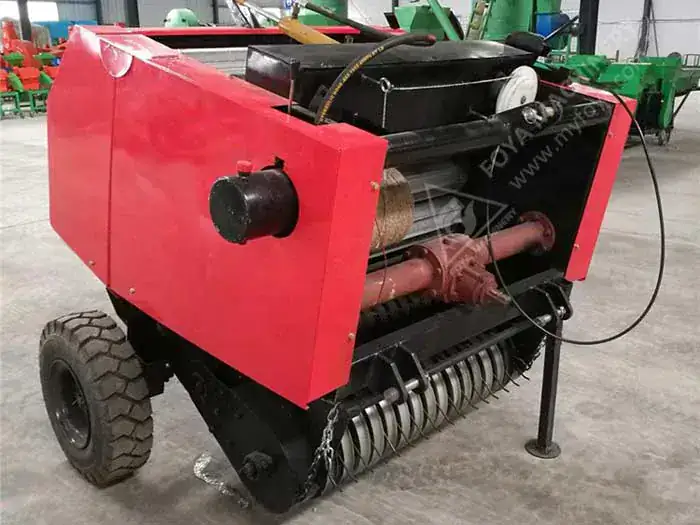
- Irregular silhouettes. Spouts, hoppers, tanks, handrails and gearbox covers create dead air. A baler measuring 4.0 × 2.3 × 1.9 m by extremes can occupy 15 CBM of billable space while its steel only fills 4 CBM.
- Not stackable. Balers, harvesters and combines carry their weight on the axle and thin-gauge panels on top. Placing a second machine on top crushes the chamber, the guards or the feed hopper. Most implements load one layer high only.
- Wheels occupy width. A 2.3 m wide machine in a 2.35 m container leaves 2–3 cm per side — no room for a strap or a batten. Pulling tyres off gains 15–20 cm per side and is the fastest way to gain a slot.
- Exposed blades and tines. Pickup tines, flails, shredder knives and reel bats are the most frequently damaged parts in transit, because they stick out beyond the frame and meet the container wall first.
- Weight versus volume. A 1.8 t round baler is well inside the payload limit but consumes 15 CBM. Small machines are the opposite: 40 corn shellers weigh 8 t and fill the container to the roof. The two families must be mixed to reach both limits at once.
- Overweight, not over-volume. Dense cargo such as crushers, steel bar benders and spare parts can hit the 26–28 t payload before the container is half full. Road leg limits in many importing countries are stricter than the container limit and require permits.
3. How Many Machines Fit in a 40HQ — Estimates
The table below is based on real FOYA loading plans in a 40HQ (12.03 × 2.35 × 2.69 m). Figures assume professional packing, timber bedding, wheels removed where noted, and no stacking unless the row says otherwise. Expect to land at 70–80% of these numbers on a first load and to reach them from the second container onwards, once the packing drawings are fixed.
| Machine | Typical packed size (L × W × H) | Unit weight | Unit CBM | 40HQ quantity | Basis / notes |
|---|---|---|---|---|---|
| Round baler | 4.0 × 2.3 × 1.9 m | 1.4–1.8 t | ≈ 15 CBM | 3–4 units | Floor only, no stacking; drawbar folded and wheels off for the 4th unit. See round baler. |
| Square baler | 4.6 × 2.2 × 1.7 m | 1.6–2.0 t | ≈ 16 CBM | 3 units | Longer than a round baler; load two at the rear and one forward on the offset centre line. Bale chute removed. |
| Silage harvester (mounted) | 3.8 × 2.1 × 2.0 m | 1.0–1.4 t | ≈ 13 CBM | 3–4 units | Discharge spout removed or rotated down; 2 units pass each other in the 2.35 m width only after tyre removal. Self-propelled units occupy 25–30 CBM each and load 1–2 per container. |
| Rice reaper / mini rice-wheat combine | 3.0 × 1.8 × 1.6 m | 0.6–0.9 t | ≈ 8 CBM | 6–8 units | Reel and divider removed and packed flat; machines nested nose-to-tail in two rows. |
| Potato harvester | 3.2 × 1.8 × 1.5 m | 0.7–0.9 t | ≈ 8 CBM | 6 units | Separator chain protected with cardboard; two rows of three. See potato harvester. |
| Corn sheller / grain thresher | 1.2 × 0.9 × 1.3 m | 0.15–0.25 t | ≈ 1.5 CBM | 30–40 units | Crated or palletised, stackable two high with a plywood deck. Belts, screens and spare parts fill the wall gaps. |
| Feed hammer mill / chaff cutter | 1.1 × 0.8 × 1.2 m | 0.12–0.20 t | ≈ 1.2 CBM | 35–45 units | Hopper and stand knocked down; knives shipped in a separate box. See chaff cutter. |
| Rotary tiller | 1.8 × 1.0 × 1.0 m | 0.25–0.35 t | ≈ 1.8 CBM | 25–30 units | Blades removed and crated separately; frames stand on edge and interlock, which recovers 20% of the apparent volume. |
Two structural conclusions follow from this table. First, big implements are volume-limited: they will never reach the payload, so the freight cost per unit is fixed by the container, not by the machine price. Second, small machines are weight-limited: at roughly 200 kg per unit, 40HQ payload allows about 120 corn shellers, but the container fills after 30–40. That gap is why mixed loading exists, and why we recommend small-machine buyers to fill the balance of the container with spare parts, blades, belts and bearings instead of paying for air.
4. CBM, Chargeable Weight and What You Actually Pay For
CBM is simply the packed envelope of one unit:
CBM per unit = Length (m) × Width (m) × Height (m)
A square baler in a 4.6 × 2.2 × 1.7 m packing envelope occupies 4.6 × 2.2 × 1.7 = 17.2 CBM. Three of them consume 51.6 CBM — nearly a full 40GP and roughly 85% of a 40HQ, before you add timber and lashing space. This is exactly why the quantity estimate and the packing drawing must be produced together.
Freight pricing follows the same numbers in two different ways:
- FCL (full container load): you pay for the whole box, whatever is inside. Cost per CBM falls as the container fills, so the target is 85–90% volume utilisation on light cargo or 90–95% payload utilisation on dense cargo.
- LCL (less than container load): you pay per revenue ton, which is the greater of 1 CBM or 1,000 kg (W/M). A 17 CBM / 1.7 t baler is charged on its 17 CBM, not its weight. Very dense items such as crushers flip to weight-based charging.
- Air freight (for urgent spare parts): volumetric weight is 1 CBM = 167 kg, i.e. 6,000 cm³ per kg. A 1.5 CBM, 150 kg gearbox is charged on 250 kg volumetric weight.
Dimensional weight is measured on the extreme points of the packed item — including the spout, the folded handle or a protruding shaft. Reducing an envelope from 4.6 × 2.2 × 1.7 to 4.6 × 2.2 × 1.4 m by removing a chute saves 3 CBM, which on a single LCL shipment can exceed the cost of the chute itself.
5. Six Things to Confirm Before Loading
Nothing on this list is optional. Each item, when skipped, has produced a damaged machine, a held container or a claim.
| # | Item to confirm | What "confirmed" means | Who provides it |
|---|---|---|---|
| 1 | Dimension drawing | A three-view drawing with the widest point, highest point and total length marked, plus the packing envelope after dismantling — not the catalogue dimensions. | Factory / technical department |
| 2 | Reinforcement method | Written specification: timber bedding size, steel chocks, lashing points used, number and rating of straps, whether cross bracing is welded or bolted. | Factory + freight forwarder |
| 3 | Wheels: fitted, removed or deflated | A decision made before loading day, with axle stands or crate feet supplied if wheels come off. Removing wheels also changes the packing envelope on the drawing. | Buyer and factory jointly |
| 4 | Crate or bare (nude) packing | Choose wooden case, pallet, or nude with protective wrapping. Any solid wood must carry the ISPM 15 / IPPC stamp; ask for photos of the stamp before the box is closed. | Factory / packer |
| 5 | Overweight and over-height declaration | Confirmed gross weight versus container payload, axle load per machine, and whether the destination road leg needs an overweight permit or an over-height route survey. | Freight forwarder |
| 6 | Photo and video evidence | Photos of each unit before loading, of the reinforcement inside the container, of the closed doors and of the intact seal number. Insurers ask for these first. | Loading supervisor |
6. A Worked Loading Plan (40HQ, Mixed Load)
Below is a text layout of a real mixed load: three round balers, six potato harvesters and a balance of small machines. Read it from the doors (front of the drawing) to the nose.
            <-- DOORS (loading side) -->              <-- NOSE -->

   +--------------------------------------------------------+
   |  [RB-2]                    |  [RB-3]                   |   Row 1 (rear): 2 round balers
   |  wheels off, on timber     |  wheels on, chocked       |   drawbars folded toward centre
   +----------------------------+---------------------------+
   |  [RB-1]  single, offset to the left, 30 cm gap right  |   Row 2: 1 baler on centre line
   +--------------------------------------------------------+
   |  [PH-1]   [PH-2]   [PH-3]  |  [PH-4]  [PH-5]  [PH-6]   |   Row 3: 6 potato harvesters
   |  nested, separators boxed  |  nested, tyres matched    |   in two columns of three
   +--------------------------------------------------------+
   |  [CS][CS][CS][CS]  [HM][HM][HM]  [RT][RT]  [BLADES]   |   Row 4: crated small units,
   |  stacked 2 high on plywood, wall gaps filled with parts|   2 layers, strapped as one block
   +--------------------------------------------------------+
   |  LASHING ZONE  |  air gap 35 cm at top for access     |   Lashings every 1.5 m,
   |                |  timber dunnage between every row    |   minimum 4 points per machine
   +--------------------------------------------------------+

   Key: RB = round baler | PH = potato harvester | CS = corn sheller
        HM = hammer mill / chaff cutter | RT = rotary tiller
The logic is simple and repeatable. Heavy, unstackable, hard-to-handle units go in first, at the rear and along one wall, where a forklift can still reach them at destination. Small crated units fill the remaining floor and the air space above them, strapped into a single block so nothing can migrate. The centre line stays as clear as the load allows, because that is where a second machine has to be pushed past the first. Finally, 30–40 cm is left under the roof, not for cargo but for the person who has to crawl in and tension the straps.
7. LCL vs FCL — When Each One Makes Sense
| Factor | LCL (shared container) | FCL (dedicated container) |
|---|---|---|
| Minimum sensible volume | From 1–2 CBM upward | From roughly 15 CBM upward |
| Pricing basis | Per revenue ton (W/M: 1 CBM or 1,000 kg) | Flat rate per container |
| Handling | Consolidated, unloaded and reloaded at a CFS — extra touch points | Loaded once at the factory, opened once at destination |
| Damage risk for machinery | Higher: your machine shares space with pallets of unrelated cargo and is handled twice | Lower: nobody else's cargo is stacked on your timber bedding |
| Transit time | 3–10 days longer (consolidation + deconsolidation) | Direct sailing schedule |
| Best for | Trial orders, one or two small machines, spare parts, mixed samples | Three or more machines, tall implements, fragile or expensive units |
The break-even is usually around 12–15 CBM. Above that, FCL is normally cheaper per unit and materially safer for a wheeled machine. Below it, LCL keeps a first order affordable — just insist on a pallet or crate, since consolidated cargo is handled by people who have never seen a baler knotter before.
8. Common Loading Damage and How to Prevent It
| Damage seen at destination | Root cause | Prevention at loading |
|---|---|---|
| Bent pickup tines, chipped flail or shredder knives | Tines touching the container wall or another unit | Cardboard or rubber edging on the contact face; 10 cm minimum air gap; blades demounted and crated |
| Crushed baler chamber, deformed feed hopper | A second unit or heavy crates stacked on a non-load-bearing panel | One layer high for wheeled implements; crates go on the floor or on a plywood deck over a rated frame |
| Paint scratches, rubbed decals, scuffed panels | Metal-on-metal movement of a few millimetres over 30 days at sea | Timber battens between every machine, rubber matting at every steel contact, lashing re-tensioned after 24 hours |
| Tyre sidewall cracks and flat spots | Straps over-tightened directly on the tyre | Strap over the axle or frame, never over the tyre; use webbing protectors; reduce tyre pressure for long voyages |
| Rust bloom on bare shafts and unpainted steel | Condensation inside a sealed steel box crossing climate zones | VCI film on exposed metal, 2–4 kg of desiccant per container, breathing space at the top, no wet timber |
| Whole-machine shift, door damage on opening | Insufficient lashing points, no timber chocks under the wheels | Cross lashing every 1.5 m, minimum four points per machine, timber chocks fore and aft of every wheel, weld-free bracing only where the frame can take it |
| Hidden water ingress, stained crates | A leaking container roof, missed by the shipper | Inspect and photograph the empty container before loading; reject any box with a damaged roof or door gasket |
9. Receiver's Pre-Unloading Checklist
Damage found and documented before unloading is a claim. Damage found after the container is empty is usually a discussion. Work through this list in order.
- Photograph the closed container and the seal before anyone cuts it, from a distance that shows the seal number and the door locking bars together.
- Verify the seal number against the bill of lading or the shipper's loading photo. A mismatch must be recorded in writing before opening.
- Note the container condition — dents in the roof, damaged corner castings, water marks, floor delamination — and photograph each one.
- Open the doors slowly and photograph the load as it appears, before touching anything. This single photo settles most disputes about shifting.
- Check for condensation, drips and damp timber. Wipe-test the roof panels and look for rust streaks running down the walls.
- Inspect lashings and chocks while the load is still secured: slack straps, broken battens and displaced wheels tell you what happened in transit.
- Unload with rated equipment. A forklift must be rated above the machine weight at the actual load centre, not on the plate at the mast.
- Count every unit and carton against the packing list, and set aside the crates containing knives, belts and spare parts for a separate count.
- Inspect before signing: pickup tines, blades, knotters, tyres, shaft ends, control levers and paint. Photograph every fault with the machine still identifiable.
- Report damage in writing within the contract window — typically 3–7 days — with photos, container number, seal number and a short description of the affected part.
Frequently Asked Questions
How many round balers fit in a 40ft container?
A typical 1.2–1.8 tonne round baler measures around 4.0 × 2.3 × 1.9 m. Because balers cannot be stacked, a 40HQ usually takes 3 units (two facing each other at the rear plus one on the centre line), or 4 units when wheels are removed and the drawbar is folded. Plan on 3 units and treat a 4th as the bonus for a well-prepared packing drawing.
Should I book a 40GP or a 40HQ for farm machinery?
For tall implements book a 40HQ. The 40GP has a door opening of about 2.28 m, while the 40HQ gives roughly 2.58 m of door height and 30 cm more internal height (2.69 m vs 2.39 m). That extra height is what allows a self-propelled silage harvester, a mounted harvester with the spout still fitted, or a stacked pallet of small machines to be loaded without dismantling. If every item in your order is under 2.2 m tall, the cheaper 40GP is enough.
What is CBM and how is it calculated for a machine?
CBM (cubic metre) is the volume of the packed item: length × width × height in metres. A machine packed in a 3.8 × 2.1 × 1.9 m envelope occupies 3.8 × 2.1 × 1.9 = 15.2 CBM. For LCL sea freight, one CBM is normally charged as one revenue ton (W/M, 1 CBM = 1,000 kg), so a 15 CBM, 1.5 tonne baler is billed on volume, not weight. Air freight uses 1 CBM = 167 kg.
Do wooden crates and pallets need fumigation for export?
Yes. Solid-wood packing — crates, pallets, dunnage and timber bracing — must comply with ISPM 15 and carry the IPPC heat-treatment or methyl-bromide stamp on at least two visible faces. Plywood and engineered timber are exempt in most countries. Missing stamps are one of the most common reasons a machinery container is held at the destination port, so always ask for photos of the stamped wood before the box is closed.
Can different machines be mixed in one container?
Yes, and mixed loading is often the cheapest way to fill a 40HQ. Load the heaviest and bulkiest machines first along one side and toward the rear, then fill the remaining floor and the air space above with small crated units such as corn shellers, grain threshers, chaff cutters or rotary tiller parts. Keep the centre line as clear as possible and leave 30–40 cm at the top for lashing access. A packing list that matches the stacking order saves hours at unloading.
What should the buyer check before unloading a machinery container?
Check the seal number and photograph the seal and closed doors before cutting it, photograph the load the moment the doors open, look for condensation or water marks along the roof line, inspect lashings and timber for slack or shift, unload with equipment rated above the machine weight, count every unit against the packing list, and inspect paint, blades, tyres and shaft ends before signing the delivery note. Report any damage with photos within the contract window, usually 3–7 days.
Need a Container Loading Plan for Your Order?
FOYA Machinery supplies agricultural machinery to more than 50 countries and produces a packing drawing and container loading plan for every order — including dimension drawings, timber and lashing specification, ISPM 15 stamped crates where required, and photographs of the load before the doors are closed. If you are planning a mixed load of balers, harvesters and small machines, send us the model list and we will return a 40HQ loading plan with quantities and CBM per unit.
Start with our round baler, potato harvester and chaff cutter product pages for base specifications, then ask us for the packed dimensions of the exact configuration you intend to buy.
Send us your model list and destination port — we will reply with container quantities, CBM and lashing specification.