If you are looking to cut grass, alfalfa, or other forage crops efficiently, a disc mower is one of the best investments you can make. Unlike traditional sickle bar mowers that rely on reciprocating blades, disc mowers use multiple rotating discs with hardened steel blades that spin at high speed. The result: faster cutting speeds, cleaner cuts, and the ability to handle heavy, tangled, or lodged crops that would clog a sickle mower.
This guide covers everything you need to choose the right disc mower for your farm — working width comparisons, tractor power matching, blade selection, price ranges, and the most common buying mistakes to avoid.
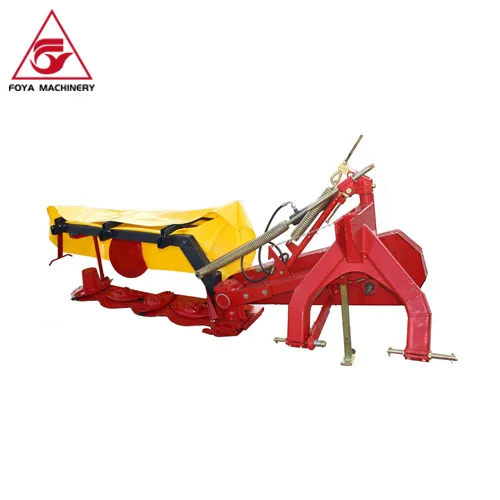
1. Disc Mower Specifications — Width vs Disc Count vs Power
Disc mowers are primarily defined by three specifications: working width, number of discs, and required tractor power. The table below shows standard configurations and what each is best suited for:
| Model | Discs | Working Width | Tractor HP | Weight | Best For |
|---|---|---|---|---|---|
| FOYA 1.6m | 4 | 1.6 m (5.2 ft) | 40-60 HP | 350 kg | Small farms, narrow fields, low HP tractors |
| FOYA 1.8m | 4 | 1.8 m (5.9 ft) | 45-65 HP | 400 kg | Small-medium farms, gentle terrain |
| FOYA 2.1m | 5 | 2.1 m (6.9 ft) | 55-75 HP | 480 kg | Medium farms, flat to rolling fields |
| FOYA 2.4m | 6 | 2.4 m (7.9 ft) | 65-85 HP | 560 kg | Medium-large farms, high productivity |
| FOYA 2.8m | 8 | 2.8 m (9.2 ft) | 80-100 HP | 750 kg | Large farms, big fields, maximum throughput |
Key insight: Wider is not always better. A 2.8m mower saves time in open fields but requires a bigger tractor and has a wider turning radius. For farms with irregular field shapes or tight gate access, a 2.1m or 2.4m model is often more practical.
2. Tractor Power Matching — Get This Right First
The most common disc mower buying mistake is mismatching tractor power. Disc mowers require sustained PTO power at 540 RPM — brief peak power ratings don't matter on a disc mower. You need consistent power to maintain blade tip speed through heavy crops and uphill sections.
Use this power matching rule: your tractor should have at least 20% more PTO horsepower than the disc mower's rated minimum requirement. This safety margin handles tough spots in the field, starts on slopes, and prevents overheating on long runs.
| Disc Mower Width | Min PTO HP Required | Recommended Tractor HP | PTO Speed |
|---|---|---|---|
| 1.6 m | 40 HP | 50-60 HP | 540 RPM |
| 1.8 m | 45 HP | 55-65 HP | 540 RPM |
| 2.1 m | 55 HP | 65-80 HP | 540 RPM |
| 2.4 m | 65 HP | 80-100 HP | 540 RPM |
| 2.8 m | 80 HP | 100-120 HP | 540 RPM |
Warning: Using an underpowered tractor with a wide disc mower causes the PTO to bog down, resulting in ragged cuts that reduce forage quality and slow regrowth. If your tractor is at the minimum HP rating, choose the next smaller mower width for reliable performance.
3. Disc Mower vs Sickle Bar vs Rotary Drum — Which Cutter Type Wins?
Farmers often ask: why choose a disc mower over a traditional sickle bar or a rotary drum mower? Here is a quick comparison:
| Factor | Disc Mower | Sickle Bar Mower | Rotary Drum Mower |
|---|---|---|---|
| Cutting speed | 8-15 km/h | 4-8 km/h | 6-12 km/h |
| Handles tangled crops | Excellent | Poor — clogs easily | Good |
| Cut quality on lodged crops | Good — discs lift standing crop | Poor — can't lift lodged stems | Moderate |
| Maintenance | Low — replace blades only | High — sections, guards, leads | Medium — belt and drum care |
| Power requirement | Medium (40-100 HP) | Low (15-40 HP) | Medium-High (50-120 HP) |
| Cutting width range | 1.6-3.0 m | 1.2-2.4 m | 1.8-3.6 m |
| Price (new) | $2,500-$12,000 | $1,500-$4,000 | $5,000-$15,000 |
For most commercial hay and silage operations, disc mowers offer the best value — they are faster than sickle bars, simpler than drum mowers, and handle a wider range of crop conditions. Browse FOYA disc mowers for models from 4-disc to 8-disc configurations.
4. Buying Checklist — 6 Things to Check Before You Buy
- Cutting height adjustment: Look for adjustable skids or rollers that let you set cutting height from 30-80 mm. Hydraulic lift from the cab is a major time-saver on larger farms.
- Blade replacement system: Disc mower blades should be replaceable without removing the disc. FOYA designs use bolt-on blades that swap in under 2 minutes per disc.
- Breakaway system: The mower must have a reliable breakaway mechanism (usually a spring-loaded pivot) that swings the cutter bar back if it hits a rock or stump, preventing gearbox damage.
- Transport position: Does the mower fold up vertically for road transport? A hydraulic folding mechanism is essential if you travel between fields on public roads.
- Swath/ windrow management: Some disc mowers include conditioning rollers (for faster drying) or swath deflectors (to control windrow placement). Consider if you need these for your haymaking workflow.
- Parts availability: Blade replacements are the most common maintenance item. FOYA offers factory-direct blade sets that ship globally, typically arriving within 5-10 business days.
5. 3 Common Disc Mower Mistakes (And How to Avoid Them)
Mistake #1: Running Blades Too Dull
Dull blades shred rather than cut grass, causing ragged tips that die back and delay regrowth. A good rule: if you can see visible fraying on freshly cut crop, stop and replace blades. Most farmers replace blades twice per season — once at mid-season and once at the end — but check every 20 hours in abrasive soils.
Mistake #2: Wrong Cutting Height
Cutting too low (under 30 mm) scalps the field, damages plant crowns, and picks up stones that destroy blades. Cutting too high (over 80 mm) leaves too much stubble, wasting potential yield. For most forage crops, 50-60 mm is the sweet spot. Adjust for the specific crop — alfalfa should be cut higher (60-70 mm) than grass (40-50 mm).
Mistake #3: Ignoring Disc Drive Belt Tension
Disc mowers use belts to drive the disc gearboxes. Loose belts slip under load, reducing cutting speed and wearing out prematurely. Check belt tension every 10 operating hours — there should be about 10-15 mm of deflection at the mid-point with moderate thumb pressure. Replace belts in pairs if one shows cracking or glazing.
Frequently Asked Questions
What tractor power is needed for a disc mower?
FOYA disc mowers require 40-100 HP depending on working width. A 1.6m (4-disc) model needs 40-60 HP, a 2.1m (5-6 disc) needs 55-80 HP, and a 2.8m (8-disc) needs 80-100 HP. Always choose a tractor with at least 20% more HP than the mower's minimum requirement for reliable field performance.
What working width disc mower should I choose?
Small farms under 20 hectares: 1.6m-1.8m. Medium farms 20-50 hectares: 2.1m-2.4m. Large farms above 50 hectares: 2.6m-2.8m. Consider your field shape and gate width — a 2.8m mower needs wide access points and open turning space.
How much does a disc mower cost?
Entry-level 4-disc mowers: $2,500-$4,500. Mid-range 6-disc mowers: $4,500-$7,000. Large 8-disc mowers: $7,000-$12,000. FOYA Machinery offers factory-direct pricing — check our models for current pricing and shipping.
How often should I replace disc mower blades?
Every 20-40 operating hours under normal conditions. Sandy or stony soils: check every 10 hours. Replace in complete sets to maintain disc balance. Signs of wear include rounded cutting edges, reduced cutting efficiency, and increased vibration.
Can I use a disc mower for silage and hay?
Yes — disc mowers work excellently for both. For silage: cut at 30-50 mm height to maximize yield. For hay: cut at 50-80 mm for faster stubble drying. FOYA disc mowers handle grass, alfalfa, clover, and mixed forage crops efficiently.
What maintenance does a disc mower need?
Daily: check blades and clean discs. Weekly: grease disc bearings every 8 hours, check gearbox oil. Monthly: inspect PTO shaft and hydraulic hoses. End of season: replace gearbox oil, store indoors with discs elevated.
Ready to Choose Your Disc Mower?
Whether you need a compact 4-disc mower for a 10-hectare hay field or an 8-disc powerhouse for 100+ hectares of silage, FOYA Machinery has a model that fits. Our disc mowers range from 1.6m to 2.8m working widths — all factory-direct with global shipping and full spare parts support.
Not sure which width and disc count fits your tractor? Contact our team for a free matching consultation — just tell us your tractor model and typical field conditions.
Contact FOYA Machinery for pricing, specifications, and shipping on disc mowers and related forage equipment.