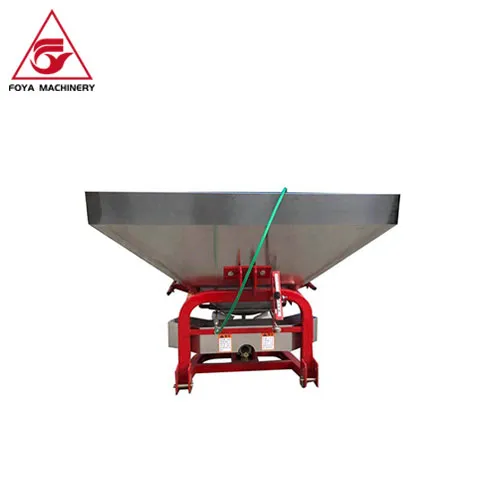
Choosing the right fertilizer spreader can make a significant difference in your crop yields and input costs. A well-matched spreader ensures uniform fertilizer distribution, reduces waste, and saves valuable time during the planting season. Whether you are using granular NPK blends, urea, or organic powder fertilizers, the right equipment determines how evenly those nutrients reach your crops.
This guide covers everything you need to know before buying a tractor mounted fertilizer spreader — from spreader types and key specifications to 2026 pricing and real-world buying recommendations. We also include comparison tables to help you evaluate different models side by side.
Types of Fertilizer Spreaders
Fertilizer spreaders fall into two main categories for tractor mounting: centrifugal disc spreaders and pendulum spreaders. Each has distinct advantages depending on your application needs.
| Feature | Centrifugal Disc Spreader | Pendulum Spreader |
|---|---|---|
| Spreading Mechanism | Rotating disc(s) fling fertilizer outward | Oscillating pendulum arm distributes material |
| Spreading Width | 6 - 15 m (adjustable) | 4 - 8 m (narrower, more precise) |
| Best For | Broad-acre field application | Precision banding near crop rows |
| Fertilizer Types | Granular, powder, urea, NPK blends | Granular only (powder may clog) |
| Price Range | $800 - $3,000 | $1,500 - $3,500 |
| Maintenance | Low — simple disc replacement | Moderate — pendulum mechanism wears |
For most farmers, a centrifugal disc spreader offers the best balance of coverage area, cost, and versatility. If you need high-precision application near sensitive crops or in narrow rows, a pendulum spreader may be worth the extra investment.
Key Specifications to Compare
When evaluating fertilizer spreaders, focus on these critical specifications. The right combination of capacity, spreading width, and tractor compatibility will determine your operational efficiency.
| Specification | Small Farm Model | Mid-Size Model | Large Commercial Model |
|---|---|---|---|
| Hopper Capacity | 200 - 400 kg | 400 - 700 kg | 700 - 1,000 kg |
| Spreading Width | 6 - 10 m | 10 - 12 m | 12 - 15 m |
| Required Tractor HP | 20 - 30 hp | 30 - 40 hp | 40 - 50 hp |
| Flow Rate Control | Manual slide gate | Adjustable metering | Precision metering + GPS-ready |
| Disc Material | Mild steel | Stainless steel | Stainless steel, hardened |
| Weight | 80 - 120 kg | 120 - 160 kg | 160 - 200 kg |
Spreading Width and Flow Rate — Getting Uniform Coverage
Uniform fertilizer distribution is the single most important factor in achieving consistent crop growth. A spreader with adjustable spreading width and flow rate gives you the flexibility to match your field layout and crop type.
Most tractor mounted spreaders use a PTO-driven centrifugal disc. The disc speed (typically 540 or 1,000 rpm) determines how far the fertilizer is thrown. Smaller discs at higher speeds produce wider spreads but may reduce uniformity on windy days. Adjustable flow gates or metering slides let you control the volume of material released per pass.
For optimal results, follow these guidelines:
- Test the spread pattern in your field before full application — lay out collection trays across the spreading width
- Adjust the flow rate based on fertilizer type: granular urea flows differently than fine powder fertilizers
- Overlap passes by 10-15% to compensate for edge tapering of the spread pattern
- Use a slower ground speed (6-8 km/h) for better uniformity, especially with powder fertilizers
- Calibrate the spreader each season — fertilizer particle sizes change between batches
Tractor Compatibility — What to Check Before Buying
Before purchasing a fertilizer spreader, verify these compatibility factors with your tractor:
- PTO horsepower: Most spreaders need 20-50 hp at the PTO. Check your tractor's PTO rating, not engine horsepower.
- Three-point hitch: Category I or II hitches are standard. Ensure your tractor's hitch can handle the spreader's weight (80-200 kg).
- PTO shaft speed: Most spreaders are designed for 540 rpm. Some large commercial units require 1,000 rpm.
- Hydraulic system: If the spreader has hydraulic flow control, verify your tractor has a spare remote hydraulic outlet.
- Ground clearance: Ensure the spreader's frame clears the ground when raised, especially for row crop tractors with low clearance.
2026 Fertilizer Spreader Price Guide
Fertilizer spreader prices vary by capacity, build materials, and features. Here are current 2026 price ranges from FOYA and comparable manufacturers:
| Model Type | Capacity | Spreading Width | Price Range (USD) |
|---|---|---|---|
| Entry-Level Disc Spreader | 200 - 400 kg | 6 - 10 m | $800 - $1,200 |
| Mid-Range Disc Spreader | 400 - 700 kg | 10 - 12 m | $1,200 - $2,000 |
| Heavy-Duty Disc Spreader | 700 - 1,000 kg | 12 - 15 m | $2,000 - $3,000 |
| Pendulum Precision Spreader | 300 - 600 kg | 4 - 8 m | $1,500 - $3,500 |
Prices include the spreader unit, PTO shaft, and mounting hardware. Shipping, customs duties, and optional accessories (GPS guidance systems, electric flow actuators) are additional. FOYA offers factory-direct pricing with volume discounts for multiple units.
Frequently Asked Questions
What size fertilizer spreader do I need for my farm?
How much does a tractor mounted fertilizer spreader cost?
Centrifugal disc vs pendulum fertilizer spreader — which is better?
What is the spreading width of a typical tractor PTO fertilizer spreader?
Where to buy a fertilizer spreader for tractor mounting?
Ready to Buy a Fertilizer Spreader?
FOYA Machinery offers a range of tractor mounted fertilizer spreaders with capacities from 200 kg to 1,000 kg, adjustable spreading widths, and durable stainless steel components. Contact our team for expert advice on choosing the right spreader for your farm size and crop type.
Also explore: Fertilizer Spreader product page | Manure Spreader | Tractor Boom Sprayer