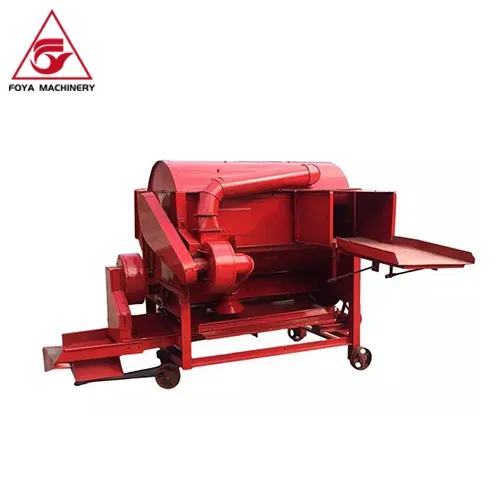
Threshing — the process of separating grain from stalks and husks — is one of the most labor-intensive steps in crop production. For small to medium farms, a dedicated grain thresher offers the most cost-effective solution, delivering clean grain ready for storage, sale, or further processing without the massive investment of a combine harvester.
This guide covers everything you need to know before buying a grain thresher: how threshing works, multi-crop capabilities, electric vs diesel power options, adjustable drum speed and concave settings, capacity selection by farm size, and 2026 pricing for different thresher configurations.
How a Grain Thresher Works
A grain thresher uses a rotating drum (also called a cylinder) with rasp bars or teeth that beat the crop against a stationary concave. This action separates the grain from the straw, husks, and chaff. The separated material then passes over sieves with a fan system that blows away lightweight chaff while clean grain falls through into a collection bin or bagging outlet.
Key components include:
- Threshing drum — rotating cylinder with rasp bars or teeth, speed adjustable from 500-1200 rpm
- Concave — stationary curved grate around the drum, clearance adjustable for different crop sizes
- Cleaning fan — variable-speed fan that removes chaff and lightweight debris
- Sieving system — oscillating screens that separate grain by size
- Feed hopper — manual or conveyor-fed intake for crop material
- Grain outlet — bagging spout or auger discharge for clean grain collection
Multi-Crop Capability — Wheat, Rice, Corn, Beans
One of the most important features of a modern grain thresher is its ability to handle multiple crop types. A good multi-crop thresher can switch between different grains with simple adjustments to drum speed and concave clearance.
| Crop | Recommended Drum Speed | Concave Clearance | Fan Speed | Threshing Difficulty |
|---|---|---|---|---|
| Wheat | 900-1100 rpm | 2-4 mm | Medium-High | Easy |
| Rice | 800-1000 rpm | 2-4 mm | Medium | Easy |
| Corn (Maize) | 500-700 rpm | 6-10 mm | Medium | Moderate |
| Soybeans | 600-800 rpm | 5-8 mm | Low-Medium | Moderate |
| Beans (Dry) | 500-700 rpm | 8-12 mm | Low | Hard |
FOYA grain threshers feature tool-free adjustments for drum speed and concave clearance, allowing operators to switch between crops in under 5 minutes. The multi-crop design makes them ideal for diversified farms that grow several grain types across the season.
Electric vs Diesel Powered Threshers
Grain threshers are available with three power options, each suited to different farm setups:
| Feature | Electric Motor | Diesel Engine | Tractor PTO |
|---|---|---|---|
| Power Range | 3-11 kW | 5-20 hp | 15-50 hp |
| Best For | Fixed location with grid power | Remote fields without electricity | Farms with available tractor |
| Operating Cost | Lowest ($0.10-$0.30/h) | Moderate ($1-$3/h fuel) | Low (tractor already running) |
| Maintenance | Low — simple electric motor | Higher — engine oil, filters | Minimal — no separate engine |
| Noise Level | Quiet | Loud | Moderate |
| Portability | Requires power connection | Fully mobile | Requires tractor |
For most small to medium farms with access to grid electricity, an electric grain thresher offers the lowest operating cost and simplest maintenance. Diesel-powered threshers are ideal for farms that need to move the machine between multiple fields. PTO-driven threshers leverage an existing tractor investment but require the tractor to remain running throughout operation.
Adjustable Drum Speed and Concave Clearance
The ability to fine-tune drum speed and concave clearance is what separates a good thresher from a great one. Incorrect settings lead to cracked grain, incomplete threshing, or excessive straw in the output.
Drum speed controls the impact force on the crop. Too fast and you crack grains or damage seed viability. Too slow and grain remains attached to the head. Most threshers offer a speed range of 500-1200 rpm with simple pulley or variable-speed drive adjustment.
Concave clearance controls how tightly the crop is pressed between the drum and concave. A smaller gap provides more aggressive threshing but risks grain damage. A larger gap is gentler but may leave grain unthreshed. Concave clearance typically ranges from 2 mm to 15 mm.
FOYA threshers feature clearly marked adjustment points and included reference charts for common crops, making setup straightforward even for first-time operators.
Capacity Selection by Farm Size
| Farm Size | Recommended Capacity | Power Required | Daily Output |
|---|---|---|---|
| Small (under 5 ha) | 500-1000 kg/h | 3-5 kW / 5-8 hp | 4,000-8,000 kg/day |
| Medium (5-15 ha) | 1000-2000 kg/h | 5-8 kW / 8-15 hp | 8,000-16,000 kg/day |
| Large (15-30 ha) | 2000-3000 kg/h | 8-11 kW / 15-20 hp | 16,000-24,000 kg/day |
A good rule of thumb: choose a thresher that can process your entire grain harvest within 7-14 working days. This allows time for weather delays, maintenance, and operator rest while ensuring your crop is threshed before quality degrades in storage.
2026 Grain Thresher Price Guide
| Model Type | Capacity | Power Source | Price Range (USD) |
|---|---|---|---|
| Small Electric Thresher | 500-800 kg/h | 3-5 kW electric | $2,000 - $3,500 |
| Medium Electric Thresher | 1000-1500 kg/h | 5-8 kW electric | $3,500 - $5,500 |
| Medium Diesel Thresher | 1000-1500 kg/h | 8-12 hp diesel | $4,500 - $6,500 |
| Large Diesel Thresher | 2000-3000 kg/h | 15-20 hp diesel | $6,500 - $9,500 |
FOYA grain threshers include the threshing unit, cleaning fan and sieve system, grain collection outlet, and operator manual. Electric models include a motor starter and power cable. Diesel models include the engine with recoil or electric start. Factory-direct pricing includes worldwide shipping arrangements and technical support.
Frequently Asked Questions
Can a grain thresher handle wet crops?
How do I adjust a grain thresher for different crops?
What is the difference between a grain thresher and a combine harvester?
How much grain can a small farm thresher process per day?
Ready to Buy a Grain Thresher?
FOYA Machinery offers a complete range of grain threshers from 500 kg/h to 3000 kg/h capacity, in electric, diesel, and PTO-driven configurations. Each thresher includes adjustable drum speed and concave clearance for multi-crop capability, a precision cleaning system, and comprehensive documentation. Contact our team for expert advice on selecting the right thresher model for your grain types and farm size.
Also explore: Grain Thresher product page | Grain Sheller | Peanut Sheller