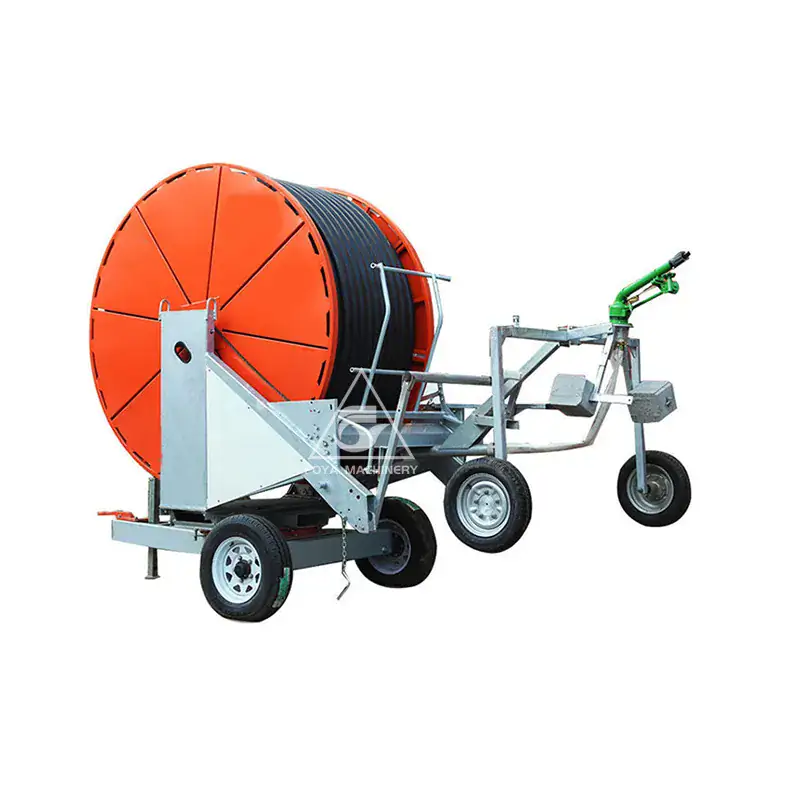
Efficient irrigation is the backbone of modern crop production, and a hose reel irrigator — also known as a traveling irrigator or self-winding reel — is one of the most versatile and cost-effective solutions for medium to large fields. Unlike fixed sprinkler systems that require extensive underground piping, a hose reel irrigator is mobile, easy to set up, and can cover multiple fields with a single unit.
This guide covers everything you need to know before buying a hose reel irrigator: how the system works, reel drive types, hose sizing, sprinkler coverage, field layout planning, 2026 pricing, and practical buying recommendations for grain, vegetable, and pasture irrigation.
How a Hose Reel Irrigator Works
A hose reel irrigator operates on a simple but effective principle. The machine consists of a large drum of PE or rubber hose mounted on a wheeled chassis. One end of the hose connects to a water supply at the field edge, while the other end has a sprinkler gun or boom. As water flows through, the reel slowly winds the hose back, pulling the sprinkler across the field in a straight line. The result: a perfectly irrigated rectangular strip in each pass.
Key components include:
- Hose reel drum — holds 200-400 m of hose, made from PE or reinforced rubber
- Drive mechanism — turbine, hydraulic, or electric motor that rotates the drum
- Sprinkler gun or boom — mounted on a wheeled cart, covers 30-80 m diameter
- Speed control — regulates hose retraction speed, determining water application depth
- Chassis and stabilizers — support the machine during transport and operation
Reel Drive Types — Turbine vs Hydraulic vs Electric
| Feature | Turbine Drive | Hydraulic Drive | Electric Drive |
|---|---|---|---|
| Power Source | Water flow through turbine | Tractor hydraulic system | Generator or mains power |
| Speed Control | Manual valve adjustment | Variable, precise control | Digital, very precise |
| Water Pressure Needed | 4 - 8 bar (consistent) | 3 - 6 bar (flexible) | 3 - 6 bar (flexible) |
| Maintenance | Low — simple turbine | Moderate — hydraulic system | Low — electric motor |
| Price Premium | Baseline | +$1,500 to $3,000 | +$2,000 to $4,000 |
| Best For | Standard farms with good water supply | Variable pressure, large fields | Precision irrigation, automated farms |
For most farms, a turbine drive hose reel irrigator offers the best value. It uses no external power — the water flow itself drives the reel. If your water pressure fluctuates significantly or you need very precise speed control for variable-rate watering, hydraulic or electric drive is worth considering.
Hose Length and Diameter — Matching to Your Field
The correct hose length and diameter ensure efficient water delivery and minimize pressure loss across the field.
| Field Length | Recommended Hose Length | Hose Diameter | Water Flow Required | Sprinkler Coverage |
|---|---|---|---|---|
| Up to 200 m | 200 m | 75 mm (3") | 20 - 40 m³/h | 30 - 50 m diameter |
| 200 - 300 m | 300 m | 90 mm (3.5") | 30 - 60 m³/h | 50 - 65 m diameter |
| 300 - 400 m | 400 m | 110 mm (4") | 50 - 80 m³/h | 65 - 80 m diameter |
A common mistake is buying a hose that is too long for the water supply. If your pump cannot deliver sufficient flow and pressure to reach the full hose length, the far end of the field will receive less water. Always match the hose diameter and length to your pump capacity. A general rule: each 100 m of hose adds approximately 0.5-1 bar of pressure loss, depending on diameter.
Sprinkler Options — Gun vs Boom
Two sprinkler configurations are available for hose reel irrigators:
- Single sprinkler gun: A large rotating water cannon mounted on a sled or wheeled cart. Covers 30-80 m diameter. Lower cost, simpler, but can damage delicate crops with high-impact water droplets.
- Boom attachment: A horizontal pipe with multiple small nozzles mounted on a wheeled cart. Covers 15-30 m width. Produces fine, gentle droplets ideal for vegetables and young crops. Higher cost but better water distribution uniformity.
For grain crops like corn, wheat, and barley, a sprinkler gun is sufficient and more economical. For vegetables, leafy greens, and high-value row crops, invest in a boom attachment for gentler, more uniform watering.
2026 Hose Reel Irrigator Price Guide
| Model Type | Hose Length | Drive Type | Price Range (USD) |
|---|---|---|---|
| Small Turbine Reel | 200 m / 75 mm | Turbine | $3,000 - $6,000 |
| Medium Turbine Reel | 300 m / 90 mm | Turbine | $6,000 - $9,000 |
| Large Hydraulic Reel | 400 m / 110 mm | Hydraulic | $9,000 - $13,000 |
| Commercial Electric Reel | 400 m / 125 mm | Electric | $12,000 - $15,000 |
FOYA hose reel irrigators come with the reel unit, sprinkler gun (or optional boom), and hose. Prices exclude water pump, supply piping, and installation accessories. Factory-direct pricing from FOYA includes worldwide shipping support and technical documentation.
Frequently Asked Questions
How does a hose reel irrigator work?
What size hose reel irrigator do I need for my farm?
How much does a hose reel irrigator cost?
What crops can a hose reel irrigator water?
Turbine drive vs hydraulic drive hose reel irrigator — which is better?
Ready to Buy a Hose Reel Irrigator?
FOYA Machinery offers a complete range of hose reel irrigators with hose lengths from 200 m to 400 m, turbine, hydraulic, and electric drive options, and sprinkler gun or boom configurations. Contact our team for expert advice on sizing the right irrigator for your field dimensions and water supply.
Also explore: Hose Reel Irrigator product page | Fertilizer Spreader | Tractor Boom Sprayer