Ask any vegetable grower what the biggest single cost of getting a crop in the ground is and most will answer the same way: the labor of planting. Transplanting tomatoes, peppers, cabbage and lettuce by hand means one worker bending over every single seedling — a slow, exhausting job that disappears a surprising share of a season's budget.
In this comparison we put hand transplanting and a tractor-mounted vegetable transplanter side by side using real, defensible numbers: labor hours per hectare, crew size, euros-and-dollars cost per acre, and the exact point where a machine pays for itself.
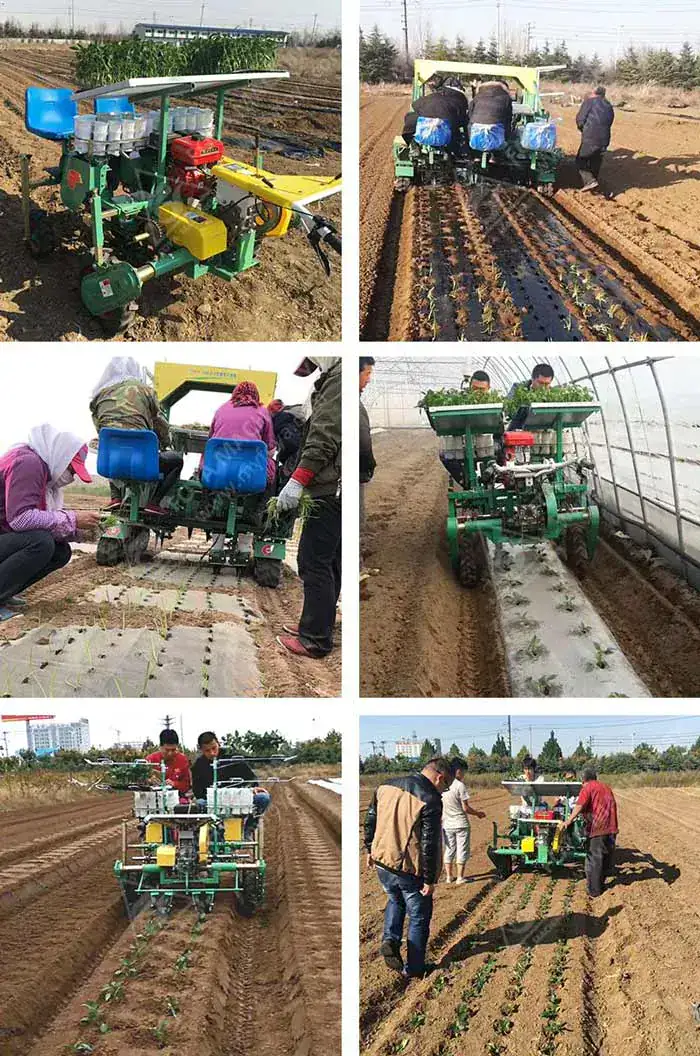
1. The Labor Math Nobody Gets Around To
Almost every vegetable that is started as a seedling — that is, tomatoes, peppers, cabbage, broccoli, lettuce, cauliflower, celery — must be placed in the ground at a spacing that leaves room to grow. Hand crews typically plant somewhere between 1,000 and 1,600 seedlings per person per hour, depending on how fit the worker is and how good the soil tilth is.
Now do the arithmetic. A single hectare of transplanted vegetables holds roughly 25,000 to 40,000 plants at typical spacings. Divide that by the 1,200-per-hour rate of an average crew member and one worker alone would need 20 to 33 hours per hectare. In practice farms run small crews, and because workers get tired, take breaks, and slow down later in the day, the real-world figure lands closer to 40 to 60 labor-hours per hectare.
Manual vs Transplanter: Head-to-Head Numbers
| Metric | Manual (Hand Crew) | Vegetable Transplanter |
|---|---|---|
| Typical crew size | 5–8 workers | 3 people (operator + 2 feeders) |
| Labor hours per hectare | 40–60 hours | 2–4 hours |
| Planting rate | 1,000–1,600 seedlings/person/hour | 3,000–6,000 seedlings/hour |
| Rows planted at once | 1 row per person | 2–4 rows |
| Labor cost per hectare* | $120–$450 | $30–$90 |
| Physical strain | High (bending, back strain) | Low (walk/travel alongside) |
| Spacing consistency | Variable, drifts through the day | Uniform, machine-set |
| Upfront equipment cost | $20–$60 (hand tools) | $800–$3,000 (machine) |
*Labor cost per hectare assumes regional wages of roughly $3–$9 per hour. Numbers will scale with local labor rates.
2. Where the Cost Per Acre Really Lives
Let's convert those hours into money. On a farm with a crew of 6 people earning the equivalent of $5 per hour, a hectare that takes 45 labor-hours costs about $225 in labor. Over a 10-hectare planting season that is roughly $2,250 that disappears out of the field-gate budget every single year, before you have spent a cent on seed, fertilizer or irrigation.
Now the same 10 hectares done by machine. A FOYA vegetable transplanter needs just 3 people — an operator plus two seedling feeders — and finishes a hectare in under 4 hours. At the same $5/hour rate, machine labor costs roughly $60 per hectare, or under $600 for all 10 hectares. That is a saving of about $165 per hectare, and $1,650 across the season, before fuel, wear and the machine itself are even mentioned.
Critically, the hand crew also incurs hidden costs that rarely get written down: extra days of temporary housing and meals during planting, hiring headaches in peak season, and the real risk of back injuries that end a worker's season — and your planting window.
3. When Does the Transplanter Pay for Itself?
This is the question every grower wants answered in money, not hours. Here is a simple rule built on the $165-per-hectare saving above:
Estimated Payback for a 2–4 Row Transplanter
| Area Planted per Season | Annual Labor Saving | Est. Machine Cost | Rough Payback |
|---|---|---|---|
| 2 hectares | ~$330 | $800–$3,000 | 4–9 seasons |
| 5 hectares | ~$825 | $800–$3,000 | 1–4 seasons |
| 10 hectares | ~$1,650 | $800–$3,000 | Within 2 seasons |
| 20+ hectares | ~$3,300+ | $800–$3,000 | Often 1 season |
The larger the area you transplant, the faster the machine writes its own purchase check. A grower planting only one or two hectares might be better served by a handheld manual tool — but almost any commercial vegetable operation that transplants 5 hectares or more crosses the payback line within a couple of seasons. When you add the yield benefit of uniform spacing, the financial case becomes stronger still.
4. Manual Tool vs Machine — Pros and Cons
Hand / Manual Transplanting
- Pros: almost no upfront cost ($20–$60 for a handheld planter), no fuel or maintenance, flexible for tiny and irregular plots, no learning curve.
- Cons: 10–20x more labor hours, high physical strain, spacing consistency drops as workers tire, slow job keeps crews off other work, hard to hire enough people at the right time.
Vegetable Transplanter (machine)
- Pros: 3,000–6,000 seedlings/hour, 2–4 rows at once, uniform depth and spacing that support better establishment, need only 3 people, natural weather/payback economics for any farm of real size.
- Cons: real purchase cost, needs a tractor for PTO or mounting, requires clean soil preparation and consistent seedlings, needs operator training.
5. How to Choose Between Them
Use these three questions as your decision filter:
- How many hectares do you transplant per season? Under 2 hectares with very cheap labor → a handheld manual tool is fine. 5 hectares or more → buy or hire a machine.
- Do you already own a tractor? If yes, a tractor-mounted model like FOYA's 2–4 row transplanter adds a big capability at a fraction of the cost of a self-propelled unit. You only add the operator plus feeders.
- Is your labor reliable at planting time? If crews are scarce, ageing, or expensive — the machine removes your dependence on a fragile labor pool.
If you plant a mix of tomatoes, peppers, cabbage, lettuce or broccoli and have a tractor, a 2–4 row vegetable transplanter is almost always the better economic choice once you pass the 5-hectare mark. For rice growers, the same labor-saving logic applies to a manual rice transplanter, which cuts paddy planting time dramatically without needing a tractor.
Frequently Asked Questions
How much does hand transplanting vegetables cost per hectare?
Hand transplanting typically takes 40 to 60 labor hours per hectare and costs roughly $120 to $450 per hectare in labor, depending on regional wages. For tomatoes, peppers, cabbage and similar transplanted crops, the effort is high because every seedling is handled and placed individually.
How many hours does a vegetable transplanter save per hectare?
A 2–4 row vegetable transplanter such as the FOYA tractor-mounted model plants 3,000–6,000 seedlings per hour, cutting a 40–60 hour hand job down to around 2–4 hours per hectare — a 10-20x reduction in crew time. Exact savings depend on crop, row spacing and field size.
When does a vegetable transplanter pay for itself?
For a farm transplanting 5–10 hectares of vegetables per season, labor savings of roughly $800–$1,650 a year typically recover the cost of a 2–4 row transplanter within one to two seasons. Operations planting 20+ hectares often pay it back in a single season.
Is a manual transplanter cheaper than a machine?
A handheld manual transplanter costs only $20–$60 and has no fuel or maintenance cost, but it still needs one worker per row and only removes bending, not labor hours. For a farm under 2 hectares with very cheap labor, a manual tool can be sensible. Above that, machine transplanting usually wins on total cost.
What crops can a vegetable transplanter handle?
Tractor-mounted transplanters handle tomatoes, peppers, cabbage, lettuce, broccoli, cauliflower, celery, onion and many crops grown from paper-pot or plug seedlings. Adjustable row and plant spacing lets one machine cover different crop geometries across the season.
Does machine transplanting improve yield or just save labor?
Both. Consistent spacing and uniform depth reduce plant-to-plant competition and improve root establishment, which can lift marketable yield. Machine planting is also far faster, so crops go in at the ideal moment rather than being spread across many days of manual labour.
Ready to Price a Vegetable Transplanter?
If your planting season is devouring hours and dollars hand-placing seedlings, the numbers above show how quickly a 2–4 row transplanter can turn that around. FOYA Machinery's team can match a machine to your crop mix, acreage and tractor, with factory-direct pricing and support in over 50 countries.
Browse the vegetable transplanter product page for full specifications, or get a personalized recommendation and quote.
Contact us for a vegetable transplanter recommendation fitted to your farm's crops and labor situation.