For small to medium-scale rice and wheat farmers, a tractor-mounted reaper is the most cost-effective way to mechanize harvesting. Unlike combine harvesters that cost tens of thousands of dollars, a rice wheat reaper attaches to your existing tractor and cuts crop stalks cleanly, laying them in neat windrows for manual collection or threshing. A good reaper can reduce harvest labor by 70% and cut field time by more than half.
But with cutting widths ranging from 1.0m to 1.8m and prices from $800 to $4,000, choosing the right one means understanding your field size, tractor power, and crop conditions. This guide breaks down every specification you need to compare, with data tables, buying tips, and answers to common farmer questions.
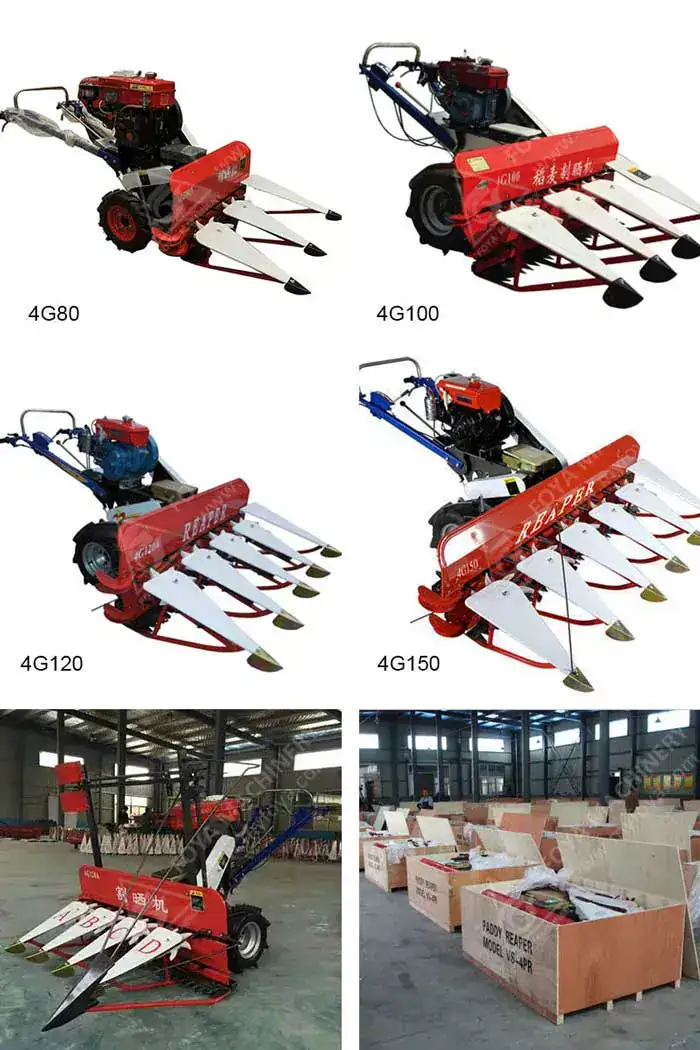
1. Model Comparison — Key Specifications at a Glance
Rice wheat reapers are primarily differentiated by cutting width, which directly determines harvesting speed and tractor compatibility. Here is how the common configurations compare:
| Model | Cutting Width | Weight | Min Tractor HP | Harvest Rate | Best For |
|---|---|---|---|---|---|
| FOYA RW-1.0 | 1.0 m | 150 kg | 15 HP | 2-3 mu/hr | Small farms, narrow paddies |
| FOYA RW-1.2 | 1.2 m | 180 kg | 20 HP | 3-4 mu/hr | Small-medium farms |
| FOYA RW-1.5 | 1.5 m | 220 kg | 25 HP | 4-6 mu/hr | Medium farms (10-30 mu) |
| FOYA RW-1.8 | 1.8 m | 280 kg | 35 HP | 6-8 mu/hr | Large farms (30+ mu), flat fields |
All FOYA rice wheat reaper models feature a gearbox-driven reciprocating blade with replaceable sections, an adjustable reel that guides crop into the blade, and a canvas conveyor that lays the cut crop in neat windrows. The cutting height is adjustable from 50-200 mm to match different crop conditions and field surfaces.
2. Cutting Width — Match to Your Field Size
Cutting width is the single most important specification. It determines how much crop you can cut per pass and directly affects harvest time:
- 1.0 m: Best for farms under 10 mu or fields with frequent turns, narrow bunds, or irregular shapes. Works with small 15-18 HP tractors. Light enough for soft-bottom paddies. Harvest rate: 2-3 mu per hour.
- 1.2-1.5 m: The sweet spot for most farms. The 1.2m offers a good balance for 10-20 mu farms, while the 1.5m suits farms up to 30 mu. Both work with common 20-25 HP tractors.
- 1.8 m: Maximum productivity for large, flat farms. Requires 30-35 HP and is best for fields with straight, long rows. Harvest rate: 6-8 mu per hour — equivalent to cutting over 40 mu per day.
Tip: Measure your field gate widths and headland turning space before choosing. A 1.8m reaper needs significantly more room to turn at row ends. If your headlands are tight, the 1.5m model may actually be faster overall despite the narrower cut.
3. Tractor Power Requirements — Getting the Match Right
Undersizing the tractor is the most expensive mistake you can make. A reaper needs sustained torque at the PTO (540 rpm), and the cutting resistance in thick, moist crop can spike. Here is the power mapping:
| Cutting Width | Min Tractor HP | Recommended HP | Hitch Category |
|---|---|---|---|
| 1.0 m | 15 HP | 18-20 HP | Category 1 |
| 1.2 m | 20 HP | 22-25 HP | Category 1 |
| 1.5 m | 25 HP | 28-30 HP | Category 1/2 |
| 1.8 m | 35 HP | 38-40 HP | Category 2 |
In wet paddy conditions, the actual power draw can be 15-20% higher than in dry fields. If your fields stay waterlogged during harvest, always choose the recommended HP over the minimum. A tractor that bogs down mid-pass causes uneven cuts, increases loss rate, and strains the PTO driveline.
4. Blade System and Build Quality
The reciprocating blade is the heart of the reaper. Here is what to check:
- Replaceable sections: Look for individual blade sections that can be swapped out when dull or chipped. Avoid models requiring full blade replacement.
- Gearbox vs belt drive: Gearbox-driven systems deliver consistent torque regardless of RPM fluctuations, ensuring clean cuts even in wet crop. Belt drives are cheaper but slip under heavy load.
- Clutch engagement: An integrated PTO clutch lets you engage/disengage the cutter without stopping — essential for obstacles and headland turns.
- Shear bolt protection: The PTO shaft should have a shear bolt or slip clutch to prevent driveline damage if the blade hits a submerged rock or root.
FOYA's rice wheat reapers use gearbox drive, replaceable high-carbon steel blade sections, and a shear bolt-protected PTO shaft as standard across all models.
5. Weight, Soil Compaction, and Wet Field Performance
At 150-280 kg, rice wheat reapers are lightweight compared to combine harvesters (several tons), so soil compaction is minimal. This is a major advantage in wet paddy conditions. The 1.0m model at 150 kg can operate in soft-bottom fields where heavier equipment would bog down. For very wet paddies, consider the lighter models and adjustable skid shoes that let you raise the cutting height in soft conditions.
6. Buying Checklist — 7 Things to Verify Before Purchase
- Cutting width vs field layout: Measure your longest runs and narrowest gate. Wider is only faster if you can use the full width.
- Tractor PTO HP: Check your tractor's PTO-rated horsepower (typically 10-15% lower than engine HP).
- Hitch compatibility: Verify your three-point hitch category matches. Most compact tractors are Category 1; larger utility tractors are Category 2.
- Blade parts availability: Confirm replacement blade sections are available. FOYA ships spares globally within 3-7 days.
- Conveyor tensioning: Look for adjustable tension — a loose conveyor slips in wet straw.
- Reel speed adjustment: Correct reel-to-ground speed ratio (1.2-1.5:1) is critical for lifting lodged crop.
- Wheel clearance: Ensure the reaper's frame clears your tractor's front wheels during tight turns.
Frequently Asked Questions
What's the difference between a rice wheat reaper and a combine harvester?
A rice wheat reaper cuts and lays crop in windrows — you collect and thresh separately. A combine harvester cuts, threshes, and cleans grain in one pass. Reapers cost 1/10th of a combine, are much lighter (150-280 kg vs 3-8 tons), and work with small tractors (15-35 HP). They are ideal for small to medium farms where combine ownership is not economical.
What cutting width should I choose for my farm?
A 1.0m width suits farms under 10 mu with narrow fields. A 1.2-1.5m width is ideal for medium farms (10-30 mu) and offers the best balance of throughput and maneuverability. A 1.8m width is for large, flat farms (30+ mu). FOYA's rice wheat reapers are available in all four widths.
How much does a rice wheat reaper cost?
Entry-level 1.0m models: $800-$1,400. Mid-range 1.2-1.5m models: $1,400-$2,500. Heavy-duty 1.8m models: $2,500-$4,000. FOYA offers factory-direct pricing — contact us for a current quote.
Can a rice wheat reaper harvest other crops?
Yes, with adjustable cutting height (50-200 mm), rice wheat reapers can harvest barley, oats, sorghum, and other cereal crops. The reciprocating blade system handles a wide range of stem thicknesses. FOYA's reapers feature adjustable reel speed and skid shoes for multi-crop versatility.
What maintenance does a rice wheat reaper require?
Daily: lubricate cutting bar and linkage, check blade sharpness, clean wrapped straw. After first 10 hours: tighten all bolts. Weekly: check gearbox oil level, inspect PTO driveline. Annually: change gearbox oil, replace worn blade sections.
Do I need a special tractor?
No — any standard tractor with a three-point hitch (Category 1 or 2) and 540 RPM PTO works. Minimum power: 15 HP for 1.0m, 20 HP for 1.2-1.5m, 35 HP for 1.8m. Most 20-40 HP compact/utility tractors are compatible.
Ready to Speed Up Your Harvest?
A well-chosen rice wheat reaper can cut your harvest time by 70%, reduce labor costs dramatically, and help you bring in the crop before weather damages it. FOYA offers a full range of tractor-mounted reapers — from compact 1.0m models to heavy-duty 1.8m units — all backed by factory-direct pricing and global shipping.
Not sure which model fits your farm? Our team can help match the right reaper to your tractor power, field size, and crop conditions.
Contact FOYA Machinery for pricing, specifications, and shipping on rice wheat reapers and related farm equipment.