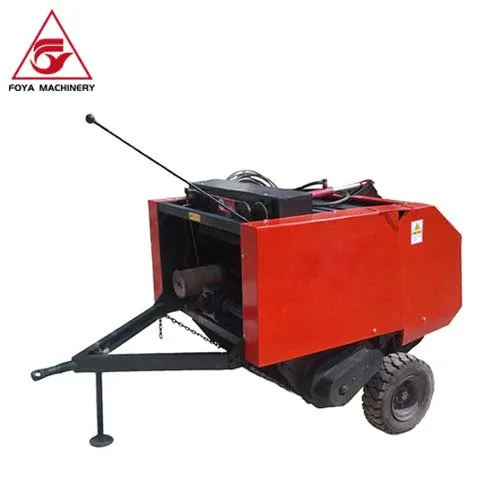
I've talked to over 50 farmers in the past year who bought a round baler and regretted it within the first season. Not because the machine was bad — but because they bought the wrong one for their operation. A round baler is a 5-10 year investment, and choosing wrong can cost you thousands in lost time, poor-quality bales, and early replacement. Here's what I've learned from those conversations, plus our own experience building balers for farms in 30+ countries.
1. Fixed Chamber vs Variable Chamber — Which One Actually Fits Your Farm?
This is the single biggest decision you'll make. There are two main chamber designs, and they serve completely different needs.
| Feature | Fixed Chamber | Variable Chamber |
|---|---|---|
| Bale size | Fixed diameter (e.g., 4x5 or 5x6 only) | Adjustable from small to large on the fly |
| Bale density | Consistent, high density every time | Lower density at small sizes, increases with diameter |
| Best for | Silage, high-moisture bales, consistent bale size | Dry hay, custom baling, varying customer requirements |
| Mechanical complexity | Simpler, fewer moving parts | More belts and rollers, higher maintenance |
| Starting price | $3,000 - $6,000 | $6,000 - $12,000+ |
My take: If you're making silage bales for your own livestock and you want consistent high density, go with fixed chamber. If you're a custom operator who needs to make different bale sizes for different clients, variable chamber gives you flexibility. For most small to medium farms making hay or straw bales, a quality fixed-chamber round baler like the FOYA models offers the best value — simple, rugged, and produces dense 220-260 kg bales that store well.
2. PTO Horsepower — Can Your Tractor Handle It?
Nothing frustrates me more than seeing a farmer hook up a round baler to a tractor that's too small. The baler works slowly, jams constantly, and the tractor labors all day. Here are the real minimums:
- 4x4 round baler (1m wide): Minimum 35-40 HP PTO. Works with most 50-60 HP tractors common on small farms.
- 4x5 round baler (1.2m wide): Minimum 50-60 HP PTO. This is the sweet spot for medium farms.
- 5x6 round baler (1.5m wide): Minimum 70-80 HP PTO. For larger operations and heavier windrows.
One farmer I know tried running a 5x6 baler with a 55 HP tractor. The baler never reached proper compression speed, producing loose bales that fell apart during handling. He ended up renting a bigger tractor — costing him $150/day. A season of that would have paid for a properly-sized setup.
Check your tractor's PTO output (not engine HP — they're different) and match it to the baler's minimum requirement. Leave at least 10-15% headroom for heavy crops and uphill work.
3. Twine vs Net Wrap — The $200 Decision That Affects Every Bale
If you're on the fence about whether to get net wrap, here's a real-world comparison from our customers:
- Twine: Costs about $0.50-1.00 per bale. Slower — each bale takes 30-60 seconds to tie. Exposes more bale surface to weather. Bales stored outside see 10-15% more spoilage on the outer layer compared to net wrapped bales.
- Net wrap: Costs about $1.00-1.50 per bale, so roughly $0.50 more. But it wraps in 5-10 seconds. Less spoilage, better bale shape, easier handling. If you make 500 bales a season, that's $250 extra cost but saves you probably 5-10 hours of tying time and 10-20 bales worth of spoilage.
We did a small test at our demo farm: 200 bales stored outside for 8 months, half twine-tied, half net-wrapped. The net-wrapped bales lost about 3% dry matter from the outer layer. The twine bales lost about 12%. When you're feeding 200 bales, that 9% difference adds up fast.
Bottom line: If you're making more than 300 bales per season or storing outside, net wrap pays for itself in the first year. Most modern round balers offer both options — get the net wrap version even if you think you'll use twine. You can always switch back.
4. Bale Diameter — Bigger Is Not Always Better
A 5x6 bale weighs about 40-50% more than a 4x5 bale of the same density. Sounds great, right? More hay per bale, fewer bales to handle. But here's what people don't think about:
- Can your loader lift a 400-500 kg bale? Many compact tractor loaders max out around 350 kg.
- Do you have a bale handler or spear rated for that weight?
- How are you transporting them? A pallet of 5x6 bales may exceed road weight limits on a standard trailer.
- For silage — bigger bales are harder to wrap evenly and take longer to ferment through.
For most small to medium farms, a 4x5 (1.2m x 1.5m) bale is the practical sweet spot. It's heavy enough to be efficient (around 250-350 kg depending on crop and moisture), but manageable with standard farm equipment.
5. Pickup Width — Why 5-10 cm Makes a Big Difference
The pickup is what gathers the crop from the windrow into the bale chamber. A wider pickup means fewer passes. But wider also means more power required and a higher price tag.
- 1.5m pickup: Standard for 4x4 and 4x5 balers. Works well with single windrows from a 2-2.5m mower.
- 1.8m pickup: Common on 5x6 balers and some 4x5 models. Handles merged windrows from larger mowers.
- 2.0m+ pickup: For high-capacity operations with big tractors.
A simple rule: match your pickup width to your mower's cutting width. If you mow with a 2.2m disc mower, a 1.5m pickup will handle a single windrow fine. If you merge two windrows, go with 1.8m. Oversizing the pickup just wastes tractor power.
6. Build Quality — What to Check Before You Buy
I've opened up cheap balers and quality balers side by side. Here's what separates them:
- Gearbox: A quality gearbox should be cast iron, not stamped steel. Ask if it uses hardened gears. Cheap gearboxes fail in 2-3 seasons on heavy silage. A good one lasts 10+ years.
- Roller bearings: Sealed bearings vs greasable. Sealed are lower maintenance but can't be serviced. Greasable bearings last longer if you actually grease them (every 8-10 hours of use).
- Frame thickness: The main frame should be at least 6mm steel on a 4x4 baler, 8mm+ on a 5x6. Thin frames twist under load, causing misalignment and premature wear.
- Tying mechanism: Knotter systems are the most finicky part of any round baler. Look for a baler with a proven knotter design — the FOYA automatic twine tying system is based on the same mechanism used by major brands, tested over thousands of bales.
7. After-Sales Support — The Hidden Factor
This is the one nobody talks about in buying guides, but it matters more than any spec on paper. A round baler has moving parts that wear — belts, chains, bearings, knives. When something breaks in the middle of baling season, you can't wait 3 weeks for a part.
Before buying, ask these three questions:
- Are spare parts in stock? How long for international shipping?
- Is there a manual with detailed diagrams and part numbers?
- Can I get video support if something goes wrong?
At FOYA, we ship spare parts within 48 hours, and our team provides WhatsApp video support in real-time. That's not a luxury — it's essential when your baler is down and the hay is ready.
1. Fixed chamber for consistent density and silage; variable for custom baling
2. Match PTO HP — leave 10-15% headroom
3. Net wrap pays for itself if you make 300+ bales
4. 4x5 is the practical size for most small-medium farms
5. Pickup width should match your mower setup
6. Check gearbox, bearings, frame thickness, and knotter design
7. Verify parts availability and support before buying
🔗 Related FOYA products mentioned in this guide:
- • FOYA Round Baler — tractor mounted, fixed chamber, 4x5 size with optional net wrap, suitable for hay, straw, and silage
- • Silage Baler Wrapper — combined baling and wrapping for silage operations, saves time and labor
- • Straw Crushing Baler — alternative option for straw collection and compaction in large-scale operations
Still not sure which round baler fits your farm? We help farmers in over 50 countries choose the right equipment. Contact us on WhatsApp or email mandy@myfoya.com — tell us your tractor model, crop type, and annual bale count, and we'll recommend the right setup.