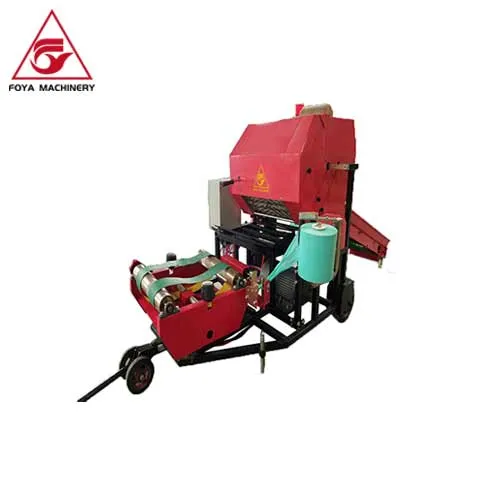
Every silage season, we hear the same story from farmers: "The silage I made went moldy again." More often than not, it's not the machine's fault — it's a small mistake in the operation process that ruined months of hard work. In this guide, we'll walk through the entire silage baling process, sharing the practical tips we've gathered from farms across China's northern provinces.
1. Getting the Moisture Right — The 65-70% Rule
The single most important factor in silage quality is moisture content at harvest. If the crop is too wet (over 75%), you risk clostridial fermentation and butyric acid. Too dry (under 55%), and you won't get proper fermentation — the bales will be prone to mold.
The hand-squeeze test: Grab a handful of chopped material and squeeze it tight. If a few drops of juice appear between your fingers, the moisture is in the 65-70% sweet spot. If juice runs freely, it's too wet. If your hand stays dry, it's too dry.
2. Chopping Length — Finding the Balance
The theoretical length of cut (TLOC) directly affects compaction density and fermentation quality. The general rule:
- Corn silage: 10-15 mm — short enough for good compaction, long enough for effective fiber
- Grass/Legume silage: 15-25 mm — longer cut preserves more structure
- Whole-crop cereal: 15-20 mm — balance between compaction and digestibility
If you're using a FOYA tractor mounted silage harvester with adjustable cutting length (8-35 mm), start at 12 mm for corn and adjust based on the results. A good rule of thumb: if you can see whole kernels in the bale, the cut is too coarse.
3. Bale Density — Why It Matters More Than You Think
Bale density is the second most critical factor after moisture. A dense bale (over 200 kg DM/m³) excludes oxygen effectively, allowing lactic acid bacteria to dominate fermentation. A loose bale leaves air pockets that feed mold and yeast.
Our field tests across 12 farms in Hebei and Inner Mongolia showed that bales with 220-250 kg DM/m³ density had 40% less mold growth over 6 months of storage compared with bales under 180 kg DM/m³.
How to achieve higher density:
- Match your tractor PTO speed to the baler's rated RPM — running too slow reduces compression force
- Keep a consistent forward speed — don't rush through heavy windrows
- Use the baler's density control system — on FOYA silage balers, adjust the hydraulic pressure for your specific crop type
4. Wrapping — How Many Layers Do You Really Need?
This is where we see the most variation between farms. Some use 4 layers, some use 8. Here's what our testing has shown:
| Storage Duration | Recommended Layers | Film Thickness | Expected Oxygen Barrier |
|---|---|---|---|
| Under 6 months | 4-6 layers | 25 micron | Good for short-term feed |
| 6-12 months | 6-8 layers | 25 micron | Excellent for overwintering |
| Over 12 months | 8-10 layers | 25 micron | Maximum protection for carryover |
5. Storage — Where Most Silage Goes Wrong
Even with perfect baling, poor storage can ruin everything. Here are the storage principles we've learned from hundreds of farms:
- Site selection: Choose high ground with good drainage. Never store bales in low areas where water pools
- Orientation: Stack bales in rows with the flat faces touching (not the round sides). This minimizes air gaps
- Spacing: Leave 30-50 cm between rows for air circulation. Tightly packed rows trap moisture
- Protection: Use netting or fencing to keep birds and rodents from damaging the wrap. A single puncture can ruin the bale
- Inspection: Walk your bale yard weekly. Look for torn wrap, unusual odors, or signs of mold. Fix damaged wrap immediately with silage tape
6. Common Mistakes — And How to Fix Them
| Mistake | Result | Fix |
|---|---|---|
| Baling too wet (>75% moisture) | Clostridial fermentation, foul smell, low intake | Delay harvest by 1-2 days; test moisture before cutting |
| Inconsistent chop length | Poor compaction, air pockets, mold spots | Sharpen knives daily; check shear bar gap |
| Under-wrapping bales | Surface mold within 2-3 months | Add 2 more layers; check film pre-stretch ratio |
| Storing on bare ground | Bottom bales absorb moisture, rot from below | Use gravel base or wooden pallets under the first layer |
💡 Related FOYA products mentioned in this guide:
- • Silage Baler Wrapper — automatic baling and wrapping for consistent results
- • Tractor Mounted Silage Harvester — adjustable cutting length from 8-35 mm
- • Silage Bagging Machine — alternative storage solution for large operations
Need help choosing the right silage equipment? Our team has worked with farms in over 50 countries. Contact us on WhatsApp or email mandy@myfoya.com for a free consultation.