🇨🇷 A First Look at Costa Rica's Dairy & Silage Industry
Costa Rica is one of Central America's most important dairy producers. With over 1,000 dairy farms concentrated in the highlands of San José, Alajuela, and Cartago, the country produces more than 1,000 million liters of milk annually. The Costa Rican dairy sector relies heavily on high-quality silage to feed Holstein and Jersey breeds through both the wet and dry seasons. Corn silage, in particular, forms the backbone of the year-round feeding program on most Costa Rican farms. As local labor costs rise and herd sizes expand, farmers are increasingly seeking mechanized solutions that can improve harvesting efficiency while reducing manual work — which is exactly where our silage harvester delivers.
🚢 Ocean Freight: From China to Puerto Limón
Shipping heavy agricultural machinery from Henan, China to Central America is a logistical undertaking. Our team coordinated every step of the journey: inland trucking from our factory in Zhengzhou to the Port of Shanghai, container loading with custom blocking and bracing to protect the machine during transit, and full-container-load (FCL) sea freight across the Pacific Ocean. The voyage took approximately 28 days, crossing through the East China Sea, transiting the Panama Canal — an engineering marvel that connects the Atlantic and Pacific — and finally arriving at Puerto Limón on Costa Rica's Caribbean coast. The container cleared customs at Limón-Moín Terminal, one of the country's busiest cargo ports handling over 4 million tons of freight annually. Documentation included a bill of lading, commercial invoice, packing list, and a Certificate of Origin for the China–Costa Rica Free Trade Agreement, which helped reduce import duties for the customer.
🔧 Unpacking & Assembly on the Farm
Once the container arrived at the customer's farm in the lush green hills outside San José, the excitement was palpable. The customer and his son immediately began unpacking the silage harvester from its reinforced crate. We had pre-assembled major sub-systems at the factory to simplify on-site setup. The remaining assembly steps included attaching the header unit, mounting the hydraulic straw basket, connecting the PTO driveline, and installing the controls. Each step was covered by detailed illustrated manuals and step-by-step video guides we provided before shipment. The customer completed the full assembly in under four hours with only basic hand tools. He remarked that the process was far simpler than assembling locally-built machinery he had purchased before.
⚙️ Running-In, Adjustment & First Field Test
After assembly, the team performed a thorough pre-operation checklist: checking all bolt torques, confirming belt tension, greasing the PTO and bearing points, and filling the gearbox with the recommended 90-weight gear oil. The first test run was conducted at half throttle with no load to allow all moving parts to seat properly. The customer then adjusted the cutting drum clearance and feed roller pressure to match the local corn variety, which averaged about 2.5 meters in height with thick stalks typical of tropical hybrids. Within two hours of fine-tuning, the machine was ready for its first real harvest. The customer harvested an entire 3-hectare plot in a single afternoon — a job that would have taken six workers three full days using manual methods. The chop length was consistent at 18–22 mm, ideal for the customer's silage pit compaction and fermentation process.
📊 Performance Evaluation & Daily Use
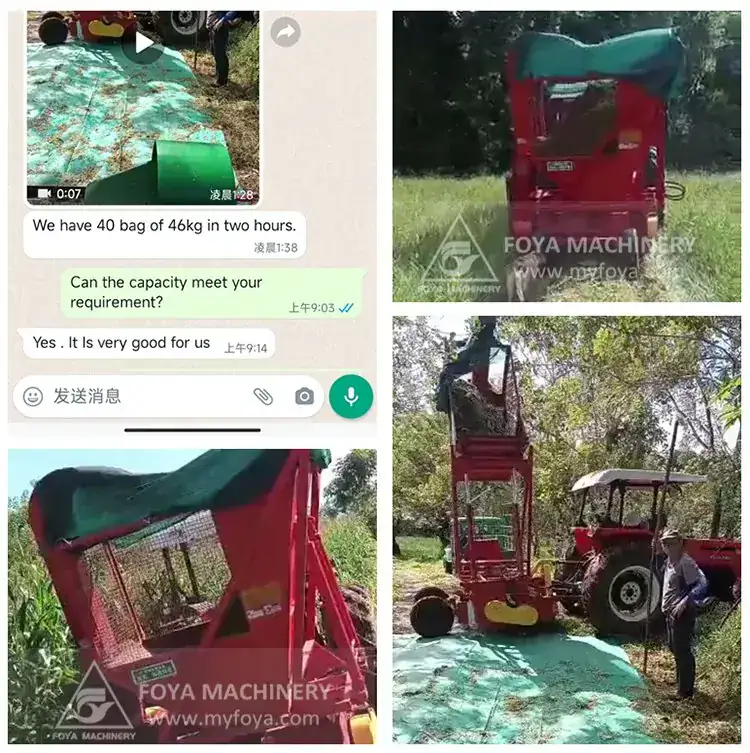
After two weeks of daily operation covering over 20 hectares, the customer shared detailed feedback. He rated the harvesting speed at 3–5 km/h in first-crop corn, producing approximately 15–18 tons of chopped silage per hour. The crushing effect was uniformly excellent, with more than 90% of kernels properly cracked — a critical factor for starch digestibility in dairy rations. The hydraulically controlled straw basket allowed him to unload directly into trailing wagons without stopping, saving additional time. Fuel consumption averaged around 6–8 liters per hour, well within expectations for a machine of this capacity. "The efficiency is beyond what I expected," the customer said. "This machine does the work of an entire crew, and the quality of the chop is better than what we achieved by hand."
💡 Why This Machine Matters for Costa Rican Farmers
Costa Rica's dairy industry is evolving. Medium-sized farms with 50–150 head of cattle need cost-effective mechanization to stay competitive against larger operations. The silage harvester fills exactly this gap — it is affordable enough for family farms, yet powerful enough to handle commercial-scale harvests. Its simple mechanical design means it can be maintained by local workshops without specialized diagnostic tools. Spare parts such as blades, belts, and bearings can be ordered directly from FOYA and shipped within days. In addition to corn silage, many Costa Rican customers use the same machine to harvest sugarcane tops, king grass (Pennisetum purpureum), and Tanzania grass — all common forage sources in Central American livestock systems. This versatility makes it a year-round investment rather than a seasonal tool.
🤝 Start Your Own Success Story
From the port of Shanghai to the pastures of Costa Rica, FOYA Machinery ensures every step is handled professionally. Whether you are a dairy farmer in Central America, a livestock operation in Southeast Asia, or a forage grower in Africa, we can tailor a shipping and support package that fits your needs. Our team provides factory-direct pricing, detailed assembly instructions, video support, and fast spare parts fulfillment. If you are interested in how our silage harvester can transform your farm's productivity, contact us today to discuss your requirements.