Transplanting vegetable seedlings by hand is back-breaking work. A team of four workers can plant roughly 0.3 acres of cabbage per day — and the results are uneven: deeper planting here, shallower there, some roots exposed, others crushed.
A vegetable transplanter changes everything. One machine with two or three workers can plant 1.5 to 3 acres per day with consistent depth, spacing, and root coverage. The seedlings grow more uniformly, survival rates climb above 95%, and your labor costs drop by 60-80%.
But with semi-automatic, fully automatic, walk-behind, and ride-on models at wildly different price points — how do you pick the right one? This guide breaks down every option with real data, cost comparisons, and practical advice for farms of all sizes.
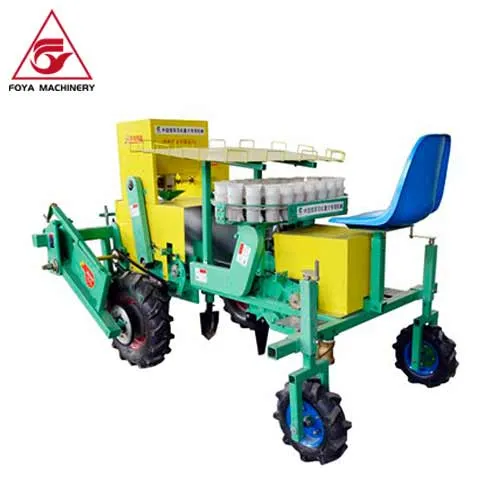
Why Your Farm Needs a Vegetable Transplanter
If you grow any tray-started vegetable crop on more than 1 acre, a transplanter pays for itself within one to two seasons. Here is why:
- Speed: A 2-row transplanter with 4 workers plants 6-10 times faster than hand transplanting.
- Consistency: Every seedling goes in at the same depth, same spacing, same angle. Uniform stands mean uniform harvests.
- Survival rate: Mechanical transplanters close the soil around roots better than hand planting, reducing transplant shock. Survival rates of 95-98% are typical vs 80-85% for hand planting.
- Labor savings: One transplanter replaces 6-10 hand transplanters. With farm labor costs rising globally, the ROI is compelling.
Vegetable Transplanter Types — Quick Comparison
There are four main types of vegetable transplanters on the market. Each serves a different farm size and budget:
| Type | Rows | Tractor Power | Workers Needed | Acres/Day | Price Range |
|---|---|---|---|---|---|
| Walk-behind (hand-fed) | 1 | None (self-propelled) | 2-3 | 0.3-0.6 | $800-$2,000 |
| Semi-auto tractor-mounted | 1-2 | 15-35 HP | 3-5 | 0.8-2.0 | $1,500-$4,500 |
| Multi-row semi-auto | 2-4 | 35-60 HP | 4-6 | 2.0-4.0 | $4,000-$8,000 |
| Fully automatic carousel | 2-6 | 50-80 HP | 2-3 | 3.0-8.0 | $8,000-$25,000+ |
What to Look for When Buying a Vegetable Transplanter
1. Row Count and Spacing
More rows mean faster planting but require wider beds and more tractor power. The table below shows common configurations:
| Rows | Typical Row Spacing | Bed Width | Min Tractor HP | Best For |
|---|---|---|---|---|
| 1 row | Adjustable 30-80 cm | Single row beds | 15 HP | Small farms, diverse rotations |
| 2 rows | 40-60 cm between rows | 80-130 cm beds | 25 HP | Medium farms, cabbage/tomato |
| 4 rows | 30-50 cm between rows | 130-200 cm beds | 50 HP | Commercial farms, leafy greens |
| 6 rows | 25-40 cm between rows | 180-250 cm beds | 70 HP | Large operations, lettuce/celery |
2. Planting Mechanism
Three main mechanisms dominate the market:
- Clip-type: Seedlings are held by clips that open when the planting shoe places them in the furrow. Accurate but slower — each clip must be manually loaded.
- Floating-dibble: A rotating wheel with dibbles (fingers) that open at the bottom, drop the seedling, and close again. Faster than clip-type, suitable for bare-root and tray seedlings.
- Carousel-type (auto): A rotating carousel picks seedlings from trays using grippers and places them into the dibble mechanism. Fully automatic — operator only refills trays. Fastest option but most expensive.
3. Transplanting Depth Control
Consistent planting depth is critical for uniform crop establishment. Look for machines with independent depth control on each planting unit. Hydraulic depth control is a premium feature that maintains depth even on uneven ground. Most mid-range machines offer mechanical depth adjustment via a lever or crank.
4. Watering System
Many modern transplanters come with a built-in watering system that dispenses a measured amount of water (typically 100-300 ml per plant) directly into the transplant trench. This settles soil around the roots, reduces transplant shock, and improves survival rates. It adds roughly $300-$800 to the machine price but usually pays for itself through better stand establishment.
Price vs Performance: Which Machine for Your Farm Size?
The right choice depends on your planted acreage and labor availability:
- Under 2 acres: A walk-behind transplanter ($800-$2,000) or a 1-row semi-auto ($1,500-$2,500). These machines are simple, easy to maintain, and suited to diversified vegetable farms.
- 2-10 acres: A 2-row semi-auto tractor-mounted transplanter ($2,500-$5,000). This is the sweet spot for most market gardens and mid-size farms. A FOYA 2-row vegetable transplanter can plant 1.5-2 acres per day with 4 workers.
- 10-50 acres: A 4-row semi-auto or entry-level automatic transplanter ($5,000-$12,000). The speed increase from 2 to 4 rows cuts transplanting time by 40-50%.
- 50+ acres: A fully automatic 4-row or 6-row transplanter ($12,000-$25,000+). These machines run with just 2-3 operators and can plant 5-8 acres per day. The labor savings alone justify the investment within 2 seasons.
5 Mistakes to Avoid When Buying a Vegetable Transplanter
- Buying too many rows: A 4-row transplanter sounds efficient, but if your beds are too narrow or your tractor lacks the horsepower, you will waste time repositioning. Buy for your current field layout, not your ideal one.
- Ignoring tray compatibility: Not all transplanters handle all tray sizes. Check that the machine accepts your standard tray format (50-cell, 128-cell, 200-cell, etc.) before buying. Converting to a new tray system is expensive.
- Skipping the watering kit: Farmers who skip the watering system to save money often regret it in dry seasons. Without water at transplant, survival rates drop 10-20% during hot weather.
- Underestimating labor needs: A 2-row semi-auto needs 4 workers (tractor driver, 2 plant feeders, 1 tray handler). A 4-row needs 6 workers. If labor is scarce, an automatic transplanter that needs only 2-3 workers is worth the premium.
- Forgetting about spare parts: Planting fingers, clips, belts, and dibble shoes wear out. Buy from a manufacturer with reliable parts supply. Chinese manufacturers like FOYA offer factory-direct parts with global shipping at competitive prices.
Crop-Specific Transplanting Tips
- Cabbage and broccoli: Plant 45-60 cm between rows, 35-45 cm in-row. Use a 2-row transplanter with watering system for best results. These crops benefit most from mechanical transplanting due to their precise spacing requirements.
- Tomatoes and peppers: Plant 60-80 cm between rows, 40-60 cm in-row. Deep planting (up to first true leaves) encourages strong root systems. A 1-row or 2-row transplanter with deep-planting capability is ideal.
- Lettuce and leafy greens: Plant 30-40 cm between rows, 20-30 cm in-row. High-density plantings benefit from 4-row or 6-row machines. Consistent depth is critical — shallow planting causes bolting in warm weather.
- Onions and leeks: Plant 20-30 cm between rows, 8-15 cm in-row. Onions require a transplanter capable of handling bare-root seedlings. Clip-type transplanters work best for these slender plants.
- Strawberries: Plant 90-120 cm between rows (on raised beds), 25-35 cm in-row. Strawberry transplanters need gentle handling to avoid damaging crowns. Tray-grown plug plants work best with automatic carousel machines.
Frequently Asked Questions
What is the difference between semi-automatic and fully automatic vegetable transplanters?
Semi-automatic transplanters require workers to place seedlings into the planting mechanism one by one. Fully automatic transplanters pick and place seedlings without manual handling. Semi-auto machines cost $1,500-$5,000 and suit small to medium farms. Fully automatic machines cost $8,000-$25,000+ and are designed for large commercial operations.
How many rows of vegetable transplanter do I need?
Under 5 acres: 1-row walk-behind. 5-20 acres: 2-row tractor-mounted. 20+ acres: 4-row or 6-row. Each additional row roughly doubles planting speed but adds 10-15 HP to tractor requirements.
What tractor power do I need for a vegetable transplanter?
1-row: 15-25 HP. 2-row: 25-40 HP. 4-row: 50-70 HP. The tractor must have a three-point hitch (category 1 or 2). Walk-behind models need no tractor at all.
What row spacing can I achieve with a vegetable transplanter?
Most models offer adjustable row spacing from 30-80 cm (12-32 inches) and in-row spacing from 15-100 cm (6-40 inches). High-end machines allow tool-less adjustment of row spacing.
Which vegetables can be planted with a transplanter?
Most tray-grown seedlings: tomatoes, peppers, cabbage, broccoli, cauliflower, lettuce, celery, kale, onions, leeks, tobacco, and strawberries. The key is consistent root ball size from standard cell trays.
How many acres can a vegetable transplanter plant per day?
1-row semi-auto: 0.5-1 acre/day. 2-row: 1.5-2.5 acres/day. 4-row automatic: 3-5 acres/day. The limiting factor is seedling loading time and tray refilling.
Where to buy a vegetable transplanter?
You can buy from local dealers, exhibitions, or directly from manufacturers like FOYA Machinery. FOYA offers tractor-mounted transplanters in 2-row and 4-row configurations. Contact us via WhatsApp or email for pricing and specifications.
Ready to Upgrade Your Transplanting Operation?
Whether you need a compact 2-row transplanter for a market garden or a high-capacity 4-row machine for commercial vegetable production — FOYA Machinery can help. Our vegetable transplanter models feature adjustable row spacing, depth control, and optional watering systems. We ship globally and provide full technical support.
Contact FOYA Machinery for pricing, specifications, and shipping on vegetable transplanters and farm planting equipment.