Introduction: Why a Combined Crush-and-Bale Machine?
Every harvest season, farmers face the same question: what to do with all the straw? Baling alone leaves long, stiff stalks that are difficult to handle, take up more space, and don't compact well. Chopping alone leaves loose material that blows away. A straw crushing baler solves both problems — it crushes stalks into short pieces (50–150 mm) and immediately compresses them into dense, uniform bales.
This buying guide covers everything you need to choose the right straw crushing baler for your farm: how capacity matches your acreage, what tractor power actually matters, how bale density affects transport costs, and where your money goes. We've included two data comparison tables to help you compare specifications side by side.
How Straw Crushing Balers Work
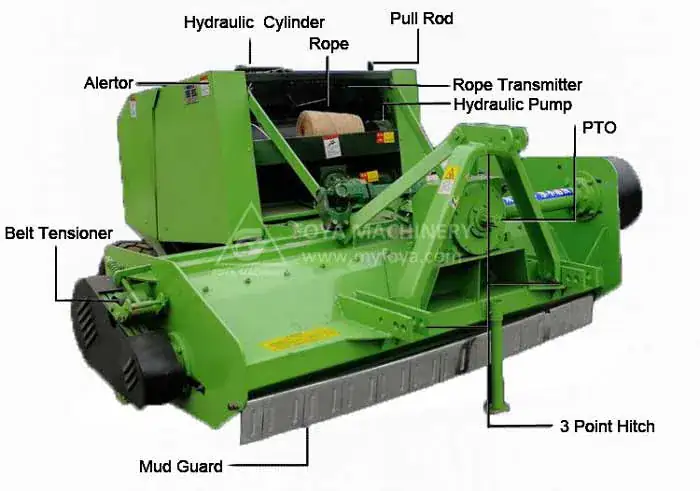
A straw crushing baler is a PTO-driven implement that performs three functions in one pass:
- Pickup — Straw is lifted from the windrow by a rotating pickup reel with spring tines
- Crushing — Material passes through a rotor with hardened blades that cut and break stalks into short pieces
- Baling — Crushed material is compressed by a plunger (square bales) or roller (round bales) into dense bales, then tied with twine
The key advantage is the one-pass operation. Traditional methods require separate chopping and baling passes, which doubles fuel consumption and labor time. A combined machine cuts field time by 40–50%.
Three Common Buying Scenarios
Scenario 1: Small Mixed Farm — Wheat & Barley Straw
If you farm 30–80 acres of wheat and barley, a 2–3 t/h capacity unit paired with a 50–65 hp tractor is ideal. You'll produce 300–500 bales per season. Look for models with 2–4 standard blades and manual feed control. Budget: $4,500–$6,500.
Scenario 2: Mid-Size Grain Farm — Wheat, Rice & Corn
For 100–300 acres of diverse crops, a 3–4 t/h unit with 60–80 hp tractor power works best. Rice straw and corn stalks are more abrasive — choose hardened alloy blades. Look for adjustable bale length (0.3–1.2 m) and auto-tying. Budget: $6,500–$9,000.
Scenario 3: Large Commercial Farm — 500+ Acres
For large operations, a 4–5 t/h heavy-duty unit with 80–90 hp tractor and hydraulic bale ejection is recommended. Expect 2,000+ bales per season. Prioritize blade durability (hardened alloy, 200+ hour life). Budget: $9,000–$12,000.
Model Comparison Table
| Model Class | Capacity (t/h) | Required PTO Power | Bale Density (kg/m³) | Blade Type | Bale Size | Price Range (USD) |
|---|---|---|---|---|---|---|
| Small / Manual | 2–3 | 50–65 hp | 150–200 | Carbon steel, 4 blades | 0.4×0.3×0.5–1.0 m | $4,500–$6,500 |
| Mid-Range / Semi-Auto | 3–4 | 65–80 hp | 180–230 | Hardened alloy, 6 blades | 0.4×0.3×0.3–1.2 m | $6,500–$9,000 |
| Heavy-Duty / Full Auto | 4–5 | 80–90 hp | 200–250 | Hardened alloy, 8 blades | 0.45×0.35×0.3–1.2 m | $9,000–$12,000 |
Cost Comparison: Straw Crushing Baler vs Alternatives
Many farmers ask whether a combined machine is worth the investment versus using separate equipment. Here's the cost breakdown:
| Method | Equipment Cost | Passes Required | Labor (hr/acre) | Fuel Cost (per acre) | 5-Year Total Cost |
|---|---|---|---|---|---|
| Straw Crushing Baler (combined) | $6,000–$9,000 | 1 | 0.3–0.5 | $8–$12 | $18,000–$28,000 |
| Flail Chopper + Standard Baler | $8,500–$14,000 | 2 | 0.6–1.0 | $16–$22 | $28,000–$42,000 |
| Standard Baler Only (no crushing) | $3,500–$6,000 | 1 | 0.3–0.4 | $6–$9 | $14,000–$22,000 |
| Custom Hire (contractor) | $0 | N/A | N/A | $0 | $25,000–$40,000 |
Note: 5-year total assumes 100 acres/year. Equipment costs are one-time. Custom hire assumes $25–$40/acre annual cost.
As the table shows, a standard baler without crushing has the lowest upfront cost, but produces long-straw bales that are harder to handle and less valuable. The straw crushing baler offers the best balance of upfront investment and operational efficiency — the crushed bales fetch 20–30% higher prices when sold for animal bedding or mushroom compost.
Key Buying Factors to Consider
1. Tractor Power — The Most Common Mistake
The #1 mistake buyers make is confusing engine horsepower with PTO horsepower. A tractor may have 80 engine hp but only 65 PTO hp. The crusher rotor requires steady PTO power at 540 rpm. If your PTO hp is insufficient, the rotor stalls when encountering thick straw mats. Always check your tractor's PTO rating, not the engine badge.
2. Bale Density Matters More Than You Think
Higher bale density (200–250 kg/m³ vs 150 kg/m³) means 25–40% fewer bales for the same tonnage. Fewer bales means less twine, fewer trips, lower labor costs, and more efficient truck/trailer loading. If you're shipping bales long distances, every 50 kg/m³ of extra density saves approximately $0.50–$1.00 per bale in transport costs.
3. Blade Life and Crop Type
Not all straw is the same. Wheat straw is relatively soft — standard carbon steel blades last 100–120 hours. Rice straw has high silica content — expect 60–80 hours with standard blades, 150–200 hours with hardened alloy. Corn stalks are the toughest — only use hardened alloy blades and expect 80–120 hours. Always ask the manufacturer for blade life estimates specific to your crop.
4. Bale Size and Application
Small bales (0.4×0.3×0.5 m, 15–25 kg) are ideal for small livestock operations — easy to handle by hand. Mid-size bales (0.4×0.3×0.8–1.0 m, 25–40 kg) work well for most farms. Large bales (0.45×0.35×1.0–1.2 m, 40–55 kg) are best for commercial operations with forklifts or loaders. Think about how you'll handle, store, and transport the bales before choosing a size.
Frequently Asked Questions
What is a straw crushing baler and how does it differ from a regular baler?
A straw crushing baler combines crushing and baling in one machine. A regular baler only compresses material into bales without crushing. The crushing function breaks straw into smaller pieces (50–150 mm), increasing bale density by 30–40% vs regular baling. This means more material per bale and better handling for feed, bedding, or biofuel.
What tractor power do I need for a straw crushing baler?
Most straw crushing balers require 50–90 hp tractors. Small models (2–3 t/h capacity) work with 50–65 hp tractors. Larger models (4–5 t/h) need 70–90 hp. Always check your tractor's PTO horsepower — not engine horsepower — because the baler's crusher rotor demands consistent PTO power at 540 rpm.
How much does a straw crushing baler cost?
Prices range from $4,500–$12,000 depending on capacity and features. Small manual-feed models start around $4,500–$6,500. Mid-range models with auto-feed systems cost $6,500–$9,000. Large high-capacity units (5 t/h+ with heavy-duty blades) range from $9,000–$12,000. Contact FOYA for current pricing and shipping to your location.
Can a straw crushing baler process wet straw?
The optimal moisture content for straw crushing and baling is 12–18%. Wet straw above 20% moisture will clog the crusher rotor and produce low-density bales that may rot in storage. Dry straw below 10% produces excessive dust and shorter chop lengths. For best results, bale within 24–48 hours after combining when straw is still slightly green but not wet.
How long do the crushing blades last and can they be replaced?
Standard carbon steel blades last 80–120 hours of operation before needing replacement. Hardened alloy blades last 200–300 hours. Blade life depends on material — wheat straw is less abrasive than rice straw or corn stalks. All blades are replaceable and cost $30–$80 per set. FOYA recommends checking blades every 40 hours and sharpening once during their lifespan.
What are the most common mistakes when buying a straw crushing baler?
The top mistakes are: (1) Buying a unit that requires more tractor power than available — always check PTO hp, not engine hp. (2) Choosing capacity that is too small — if you have 50+ acres of wheat, a 2 t/h unit will cause bottlenecks. (3) Ignoring bale density — lower density means more bales to transport. (4) Not checking blade type for your crop — rice straw needs hardened blades. (5) Forgetting to verify PTO shaft compatibility with your tractor model.
Recommended Product
FOYA's Straw Crushing Baler is a combined crush-and-bale machine with a capacity of 2–5 tons/hour, compatible with 50–90 hp tractors. It produces dense bales (150–250 kg/m³) suitable for animal bedding, feed, biofuel, and mushroom compost. Features adjustable bale length, hardened alloy blade option, and durable PTO-driven construction. Contact FOYA for a quote or technical consultation.
Also read: Straw Baling vs Chopping Cost Comparison and FOYA Silage Baler for similar forage handling equipment.
💬 Need Help Choosing the Right Straw Crushing Baler?
Our team can help match the right model to your tractor, crop type, and farm size. Get free expert advice and a competitive quote.
Chat on WhatsApp → ✉️ Email Us